<!-- -*- Mode: xml; sgml-indent-step: 1 -*- -->
<!DOCTYPE html PUBLIC "-//W3C//DTD XHTML 1.1 plus MathML 2.0//EN" "http://www.w3.org/TR/MathML2/dtd/xhtml-math11-f.dtd">
<!-- Note that the DOCTYPE is not there for validity checking but for
entities. Give me a way to use entities without a DTD and the DOCTYPE
line will disappear. -->
<html xmlns="http://www.w3.org/1999/xhtml" xmlns:hacks="urn:damowmow-com:hacks">
 <head>
  <title>Using Data Mining Techniques with the 2df QSO Redshift Survey Spectra to Locate Damped Lyman Alpha Systems</title>
  <meta name="author" content="Ian Hickson"/>
  <style type="text/css">

<!--
  Headers: Using Data Mining Techniques with the 2df QSO Redshift Survey Spectra to Locate DLAs
  Footers: Ian Hickson, Page # of #
  Margins: 0.5in 0.25in 0.5in 0.75in
-->

   body { margin: 2em; font: 1em/1.8 Times New Roman, serif; text-align: justify; }
   div { page-break-before: always; page-break-after: always; }
   h1 { font: 600 1.75em/1.5 Times New Roman, serif; text-align: center; }
   h2 { font: 600 1.5em/1.5 Times New Roman, serif; text-align: left; margin: 1em 0 0.5em 0; }
   h3, h4, h5 { font: 600 1.3em/1.5 Times New Roman, serif; text-align: left; margin: 1em 0 0.5em 0; }
   h1, h2, h3, h4, h5, h6 { page-break-after: avoid; }
   p.byline { font: italic 100 1.2em/2 Times New Roman, serif; text-align: center; }
   p, p.math + p, p.ref + p { margin: 0; text-indent: 0; }
   p.ref { text-align: left; }
   p + p { text-indent: 2em; }
   dl { margin: 0; padding: 0; }
   dt { margin: 1em 0 0.25em 0; font-weight: bolder; text-align: left; }
   dd { margin: 0 0 0.75em 2em; }
   mtd { text-align: left; }
   mtable { border-spacing: 0.1em; }
   dl.notation { display: table; width: 100%; margin: 1em 0; border: 0; }
   dl.notation > row { display: table-row; }
   dl.notation > row > dt { display: table-cell; padding: 0 0 0 2em; width: 3em; }
   dl.notation > row > dd { display: table-cell; }
   p.math, p.math + p.math { text-align: center; margin: 1em -1.5em; }
   p.math[title]:before { content: "(" attr(title) ")"; height: 0; display: block; text-align: right; }

   img { width: 5in; }

   pre { white-space: -moz-pre-wrap; }

   .contents { display: none; }
   .contents p { text-indent: 0; display: table; width: 100%; -moz-xul-box-orient: horizontal; text-align: left; line-height: 1.1; }
   .contents p span { white-space: nowrap; display: table-cell; } 
   .contents p span:first-child + span { width: 100%; vertical-align: top; } 
   .contents p span > span { border-bottom: 2px dotted; display: block; margin: 1.2em 1em 0; }

   :link, :visited { color: black; text-decoration: none; }

  </style>
 </head>
 <body>

  <h1>Using Data Mining Techniques with the 2df QSO Redshift Survey
  Spectra to Locate Damped Lyman Alpha Systems</h1>

  <p class="byline">Ian Hickson</p>
  
  <h2>Abstract</h2>

  <p>Spectra from the 2df QSO redshift survey are analysed first using
  algorithmic methods and then using a neural network. The data is
  found to be too unpredictable for simple algorithms to detect DLAs,
  although many oddities are discovered and the algorithms could be
  used for looking for other, more obvious patterns. This conclusion
  is backed by the neural network results, which indicate that the
  data is too varied for a simple back-propagation error correction
  algorithm. It is suggested that to avoid falling into local minima,
  a neural network could be evolved using genetic algorithm
  techniques. A C++ implementation of a feed forward trilayer
  perceptron is provided.</p>

  <div class="contents">
    <h2>Contents</h2>
    <p><span>Abstract</span> <span><span/></span> <span>1</span></p>
    <p><span>Contents</span> <span><span/></span> <span>2</span></p>
    <p><span>1. Introduction</span> <span><span/></span> <span>3</span></p>
    <p><span>1.1. Damped Lyman alpha systems</span> <span><span/></span> <span>3</span></p>
    <p><span>1.2. The 2df QSO redshift survey</span> <span><span/></span> <span>4</span></p>
    <p><span>1.3. The 2QZ 10K Catalogue</span> <span><span/></span> <span>5</span></p>
    <p><span>2. The algorithmic approach</span> <span><span/></span> <span>5</span></p>
    <p><span>2.1. Basic program design</span> <span><span/></span> <span>5</span></p>
    <p><span>2.2. Smoothing</span> <span><span/></span> <span>5</span></p>
    <p><span>2.2.1. Bad pixels</span> <span><span/></span> <span>6</span></p>
    <p><span>2.2.2. Moving average</span> <span><span/></span> <span>6</span></p>
    <p><span>2.2.3. Fourier transformation</span> <span><span/></span> <span>6</span></p>
    <p><span>2.3. Patterns: Extended Minima</span> <span><span/></span> <span>6</span></p>
    <p><span>2.3.1. Algorithm</span> <span><span/></span> <span>7</span></p>
    <p><span>2.3.2. Conclusions</span> <span><span/></span> <span>7</span></p>
    <p><span>2.3.3. Discoveries</span> <span><span/></span> <span>7</span></p>
    <p><span>2.4. Patterns: Gradients</span> <span><span/></span> <span>8</span></p>
    <p><span>2.4.1. Algorithm</span> <span><span/></span> <span>8</span></p>
    <p><span>2.4.2. Conclusions</span> <span><span/></span> <span>8</span></p>
    <p><span>2.5. Looking for dips: Version 2</span> <span><span/></span> <span>8</span></p>
    <p><span>2.5.1. Discoveries</span> <span><span/></span> <span>9</span></p>
    <p><span>2.5.2. Conclusions</span> <span><span/></span> <span>11</span></p>
    <p><span>2.6. Directions for future researh</span> <span><span/></span> <span>11</span></p>
    <p><span>3. The neural network approach</span> <span><span/></span> <span>11</span></p>
    <p><span>3.1. Feed Forward Trilayer Perceptrons (FFTPs)</span> <span><span/></span> <span>11</span></p>
    <p><span>3.1.1. Transfer Function</span> <span><span/></span> <span>12</span></p>
    <p><span>3.1.2. Equations</span> <span><span/></span> <span>12</span></p>
    <p><span>3.2. Back-Propagating Differential Error Correction</span> <span><span/></span> <span>13</span></p>
    <p><span>3.3. Implementation</span> <span><span/></span> <span>17</span></p>
    <p><span>3.4. Training Data</span> <span><span/></span> <span>19</span></p>
    <p><span>3.5. Analysis</span> <span><span/></span> <span>19</span></p>
    <p><span>3.6. Variations</span> <span><span/></span> <span>20</span></p>
    <p><span>3.7. Directions for future research</span> <span><span/></span> <span>20</span></p>
    <p><span>4. Appendix: References</span> <span><span/></span> <span>20</span></p>
    <p><span>4.1. Acknowledgements</span> <span><span/></span> <span>21</span></p>
    <p><span>6. Appendix: Data Sets</span> <span><span/></span> <span>21</span></p>
    <p><span>7. Appendix: Source</span> <span><span/></span> <span>23</span></p>
    <p><span>7.1. <code>ffmp.h</code></span> <span><span/></span> <span>23</span></p>
    <p><span>7.2. <code>ffmp.cpp</code></span> <span><span/></span> <span>24</span></p>
  </div>

  <h2>1. Introduction</h2>
  
  <p>The aim of this project was to use automated techniques to locate
  previously undiscovered damped Lyman alpha systems amongst the 2df
  QSO Redshift Survey data. [1]</p>

  <h3>1.1. Damped Lyman alpha systems</h3>

  <p>Damped Lyman alpha systems arise when light emitted from a
  quasistellar object (or QSO) goes through a gas cloud on its way to
  the observer. [2] When the photons interact with the hydrogen
  atoms in the gas cloud, the hydrogen atoms absorb some of the
  radiation, primarily the photons with wavelength 1216&Aring;, the
  Lyman series of the Hydrogen atom.</p>

  <p>Due to the doppler shift caused by cosmic expansion, the photons
  in question usually correspond to different inital wavelengths and
  show up as dips at different wavelengths upon reaching the observer.
  The redshift can be used to determine the distance to the gas cloud,
  and the width of the damped system can be used to determine the
  column depth of the cloud.</p>

  <p>It is believed that gas clouds dense enough to noticably affect
  backlighting QSO spectra are galaxies in early stages of
  formation. As data on protogalaxies and gas clouds is useful in
  refining models for galactic evolution, damped Lyman alpha systems
  found in the data highlight targets for further study.</p>

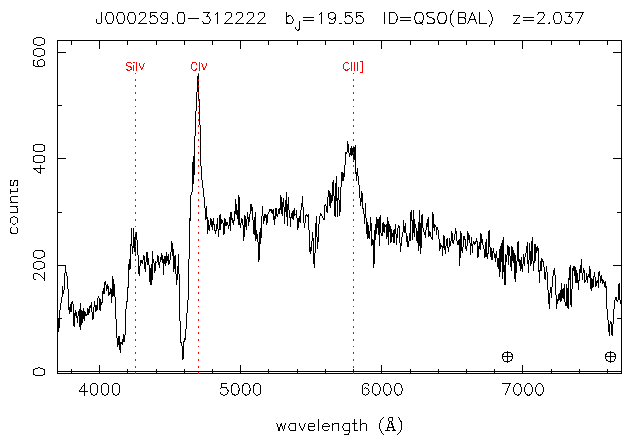
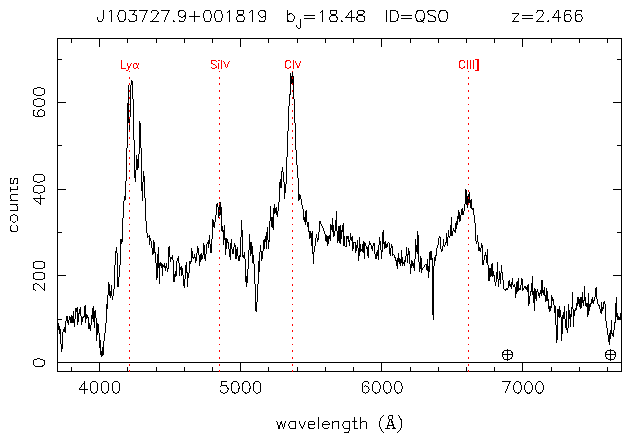
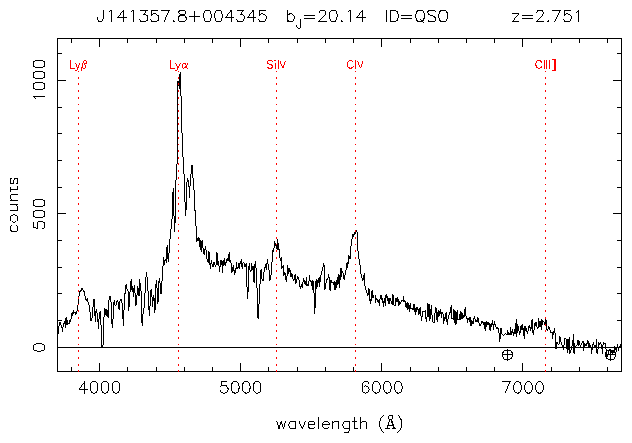
  <p>Below are some typical damped Lyman alpha systems. (All graphs
  courtesey of the 2df QSO 10K Catalogue. [1])</p>

  <dl>

   <dt>J000259.0-312222a</dt>

   <dd>This spectrum is damped between 4100&Aring; and
   4200&Aring;. This is a very narrow dip and represents the smallest
   such feature that should be considered a match. </dd>

   <dd><img src="graphs/J000259.0-312222a.gif" alt=""/></dd>


   <dt>J103727.9+001819</dt>

   <dd>A spectrum with a narrow dip around 4000&Aring;</dd>

   <dd><img src="graphs/J103727.9+001819a.gif" alt=""/></dd>

<!--
   <dt>J105811.9-023725</dt>

   <dd><img src="graphs/J105811.9-023725a.gif" alt=""/></dd>


   <dt>J110624.6-004923</dt>

   <dd><img src="graphs/J110624.6-004923a.gif" alt=""/></dd>


   <dt>J120838.1-025712</dt>

   <dd><img src="graphs/J120838.1-025712a.gif" alt=""/></dd>


   <dt>J121318.9-010204</dt>

   <dd><img src="graphs/J121318.9-010204a.gif" alt=""/></dd>


   <dt>J121957.7-012615</dt>

   <dd><img src="graphs/J121957.7-012615a.gif" alt=""/></dd>

-->
   <dt>J141357.8+004345</dt>

   <dd>This spectrum shows a classic Lyman forest at around
   4000&Aring;, and was highlighted by P. J. Outram, et al [3] as a
   subject for further study.</dd>

   <dd><img src="graphs/J141357.8+004345a.gif" alt=""/></dd>

<!--
   <dt>J215102.9-303642</dt>

   <dd><img src="graphs/J215102.9-303642a.gif" alt=""/></dd>


   <dt>J220650.0-315405</dt>

   <dd><img src="graphs/J220650.0-315405a.gif" alt=""/></dd>


   <dt>J220738.4-291303</dt>

   <dd><img src="graphs/J220738.4-291303a.gif" alt=""/></dd>


   <dt>J000534.0-290308</dt>

   <dd><img src="graphs/J000534.0-290308a.gif" alt=""/></dd>


   <dt>J012526.7-313341</dt>

   <dd><img src="graphs/J012526.7-313341a.gif" alt=""/></dd>
-->
  </dl>

  <h3>1.2. The 2df QSO redshift survey</h3>

  <p>The survey was conducted using one of the world's most advanced
  telescope systems, the Anglo-Australian Telescope 2 Degree Field
  facility.</p>

  <p>The Anglo-Australian Telescope (AAT), completed in June 1975
  [4], is an equatorially mounted 4-metre telescope. Prior to the
  1970s, most of the large telescopes were located in the northern
  hemisphere, and were thus unable to study many of the closest radio
  galaxies, as well as the center of our own. [5]</p>

  <p>The AAT can be used in many different configurations, using
  various instruments and detectors. In the configuration used for the
  2df QSO redshift survey, the AAT consisted of a wide field
  corrector, an atmospheric dispersion compensator, a robot gantry,
  two spectrographs, and a tumbling mechanism. In this configuration
  the covers wavelengths from 3500&Aring; to 8000&Aring;.</p>

  <p>The tumbling mechanism enabled one field plate of optic fibres to
  be configured by the robot while simultaneously another plate of
  optic fibres, connected to the spectrographs, was analysed. As both
  these processes take approximately an hour to complete, this setup
  allowed the spectra to be collected simultaneously and continuously
  in an automated fashion. [6] Each spectrograph was able to analyse
  200 objects at a time, allowing for a total of 400 spectra to be
  collected during each cycle.</p>

  <h3>1.3. The 2QZ 10K Catalogue</h3>

  <p>Note that the survey was conducted for the purpose of confirming
  the identity of suspected QSOs and to find their redshift. For this
  reason, the typical signal-to-noise ratio (S/N) of the spectra is in
  the region of 10, and the resolution appoximately 8&Aring;. This is
  not optimal for searching for DLAs. [3]</p>

  <h2>2. The algorithmic approach</h2>

  <p>The first approach consisted of a set of algorithms applied to
  the data, in a traditional deterministic manner.</p>

  <!--<p class="note">note about code snippets not necessarily being
  directly pluggable into the main codebase due to the evolution of
  the codebase.</p>-->

  <h3>2.1. Basic program design</h3>

  <p>The program evolved significantly over the life of this project,
  but the main design remained the same throughout.</p>

  <p>First, data is extracted from the FITS (Flexible Image Transport
  System) data files provided on the 2df data CDROM. [1] To extract
  data from the FITS files, the CFITSIO library was used. [7] This
  library provides a portable subroutine-based API for reading and
  writing FITS data files.</p>
  
  <p>The FITS files used by 2df survey consisted of a 1024 element
  spectrum (scaled by the standard BSCALE and BZERO headers), a 1024
  boolean bad pixel mask, and a median sky spectrum. [8] [9]</p>

  <p>Originally, spectra not associated with QSOs were then
  discarded. However, it was discovered that the spectrum
  labelling of the 2df data is unreliable, and this step was
  sebsequently skipped.</p>

  <p>Finally, the data was smoothed and then analysed, flagging
  potential matches.</p>

  <p class="note">Some implementation details, such as optimisations
  used to ease development, shall not be described in this report.</p>

  <h3>2.2. Smoothing</h3>

  <p>The spectra have a lot of high frequency noise. To reduce the
  number of false negatives, the data had to be smoothed.</p>

  <h4>2.2.1. Bad pixels</h4>

  <p>The data included, for each spectrum, a bad pixel mask. This
  is a list of which of the 1024 values should be considered
  invalid during analysis.</p>

  <p>Bad pixels can arise from several different sources, including
  poor weather, and edge effects (all the spectra have some
  number of bad pixels at the start and end of the data).</p>

  <h4>2.2.2. Moving average</h4>

  <p>The simplest smoothing algorithm used consisted simply of
  applying a smoothing average: taking the mean of the valid values
  present in the last <var>n</var> points as the value of each
  pixel.</p>

  <p>Various windows were tried, a window of 10 data points resulted
  in reasonable smoothing without losing the major features of the
  data.</p>

<!--
  <dl>

   <dt> 10</dt>

   <dd> insert sample graph here</dd>

   <dt> 100</dt>

   <dd> insert sample graph here</dd>

  </dl>
-->

  <p>Because of the bad pixels, there were points in the output of
  this algorithm that would have no value (if more than <var>n</var>
  bad pixels appeared together). To work around this, a simple linear
  extrapolation was then applied to the gaps.</p>

<!--  <p> sample</p> -->

  <p>While this algorithm had a moderate success in removing some of
  the noise, it was not satisfactory and was quickly discarded.</p>

  <h4>2.2.3. Fourier transformation</h4>

  <p>This second method provided much smoother results. A fourier
  transform was used to perform a transformation into the frequency
  domain, cut out the high frequency noise, then convert the data back
  to the time domain. (Note that technically the time domain was the
  frequency domain and the frequency domain the time domain, but this
  is ignored here for clarity.)</p>

  <p>The transform was implemented using the FFTW, a high performance
  portable API that uses self-adapting techniques to optimise itself
  for the machine architecture and type of data being transformed.
  [10]</p>

  <p>Trial and error found that cutting approximately the top 90% of
  the data resulted in the smoothest data still resembling the
  original.</p>

  <p class="note">For more detail on the FFTW algorithms used,
  see [11].</p>

  <h3>2.3. Patterns: Extended Minima</h3>

  <p>The initial approach was developed prior to having analysed the
  data in much detail. It was based on the assumption that damped
  systems would characteristically approach zero, while undamped
  signals would not.</p>

  <h4>2.3.1. Algorithm</h4>

  <p>For each spectrum, each good pixel was examined in turn. A count
  of how many pixels in a row had a value less than a particular
  threshold was found. Any spectrum with a suitably wide number series
  of such low values was then flagged.</p>

  <p>The threshold used was a little above 0, as the intention was to
  catch damped systems that approached the zero baseline.</p>

  <h4>2.3.2. Conclusions</h4>

  <p>Unfortunately, it turns out that a large number of the spectra
  are miscalibrated, resulting in most having numbers near, or even
  below, zero. (Note that the spectra have indeed not been flux
  calibrated, so this is not unusual.) Therefore this technique is
  unsuitable for finding damped systems in the 2QZ 10k catalogue.</p>

  <h4>2.3.3. Discoveries</h4>

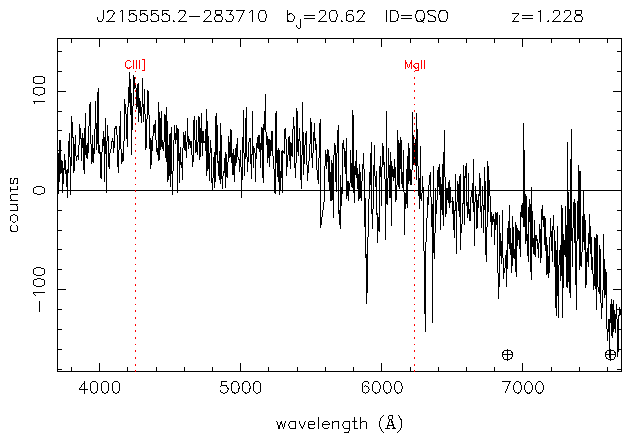
  <p>While no damped Lyman alpha systems were discovered using this
  technique, several oddities were flagged.</p>

  <dl>

   <dt>J024412.2-293014</dt>

   <dd>This spectrum appears to be galactic in nature (rather than a
   QSO, as it is labelled).</dd>

   <dd><img src="graphs/J215555.2-283710a.gif" alt=""/></dd>

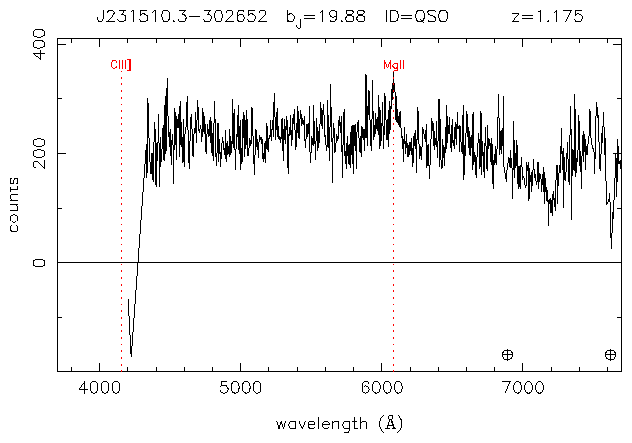
   <dt>J215555.2-283710a</dt>

   <dd>This spectrum has a mean value less than zero, indicating
   significant miscalibration.</dd>

   <dd><img src="graphs/J231510.3-302652a.gif" alt=""/></dd>

 </dl>

<!--
   <dt>more</dt>

   <dd>
<pre>
   Object: J234715.0-272642 contained 1 dips, the last.ending at 249.   Low: -52.3609;  High: 64.9442; Mean: 6.43804
      file:///home/ianh/University/Project/data/gif/ra23_24/J234715.0-272642a.gif
      no Ly-alpha; could be misidentified?

   Object: J003457.1-275425 is almost all around 0.
      file:///home/ianh/University/Project/data/gif/ra00_01/J003457.1-275425a.gif
      miscalibrated? (Ly-alpha near blue end so can't see a dip anyway)

   Object: J012347.7-280350 is very close to 0 all around.
      file:///home/ianh/University/Project/data/gif/ra01_02/J012347.7-280350a.gif
      file:///home/ianh/University/Project/data/gif/ra01_02/J012347.7-280350b.gif
      seems ressonable
      two QSOs on one spot

   Object: J013707.1-313305 touches zero quite a lot.
      file:///home/ianh/University/Project/data/gif/ra01_02/J013707.1-313305a.gif

   Object: J014049.4-281545 may contain 1 dip at the beginning.
      file:///home/ianh/University/Project/data/gif/ra01_02/J014049.4-281545a.gif
      big dip? atmospheric abs? look further.

   Object: J021928.2-275634 appears to basically be noise around zero.
      file:///home/ianh/University/Project/data/gif/ra02_03/J021928.2-275634a.gif
      no Ly-alpha; could be misidentified?

   Object: J023851.4-291607 has potential - it lifts from zero to about 25.
      file:///home/ianh/University/Project/data/gif/ra02_03/J023851.4-291607a.gif
      could be misidentified?

   Object: J030604.7-290616 barely lifts above zero.
      file:///home/ianh/University/Project/data/gif/ra03_04/J030604.7-290616a.gif
      no Ly-alpha; could be misidentified?

   Object: J114626.1+004618 barely lifts above zero as well.
      file:///home/ianh/University/Project/data/gif/ra11_12/J114626.1+004618a.gif
      no Ly-alpha; could be misidentified? could be miscalibrated?

   Object: J115948.5+003203 barely lifts above zero as well.
      file:///home/ianh/University/Project/data/gif/ra11_12/J115948.5+003203a.gif
      looks stellar

   Object: J143414.1-011449 has more under zero than above!!
      file:///home/ianh/University/Project/data/gif/ra14_15/J143414.1-011449a.gif
      miscalibrated?
</pre>
-->

  <h3>2.4. Patterns: Gradients</h3>

  <p>This approach was built on the experience gained from examining
  the spectra highlighted by the zeroes algorithm.</p>

  <p>It is based on searching for a period of characteristic decrease
  in value over a short period, following a similar characteristic
  increase in value.</p>

  <h4>2.4.1. Algorithm</h4>

  <p>For each value in the array, compare the value to the previous
  one. If the last few values have been decreasing but the last step
  is an increase, remember this point as the last decrease and
  remember how many decreases happened in a row. Otherwise, if this is
  an increase and there have been enough increases in a row, and the
  last decrease is suitably far away, and there were enough decreases
  in a row, flag this spectrum and move to the next one.</p>

  <h4>2.4.2. Conclusions</h4>

  <p>In practice, this does not work at all, because the signal (even
  after excessive smoothing) still contains perturbations (high
  frequency noise) on the up and down curves.</p>

  <p>Another problem is that this algorithm highlighted many spectra
  with two adjacent clean peaks.</p>

  <h3>2.5. Looking for dips: Version 2</h3>

  <p>To get around the limitations of the first version, a new
  algorithm was developed by looking for the following
  characteristics:</p>

  <ul>

   <li>The dips have a minimum width and a maximum width.</li>
   
   <li>The average value in a dip is lower than the average values on
   either side of the dip.</li>

   <li>The sides of the dip have to change by a certain amount within a certain width.</li>

  </ul>

  <p>The algorithm is more involved and is best explained through the
  following pseudo-code:</p>

  <ol>

   <li>Set <var>lastDown</var> and <var>lastUp</var> to 0.</li>

   <li>Starting at a certain distance from the left margin (to skip
   edge noise and have enough room to later average it if required),
   and stepping through each value until a certain distance from the
   end of the data:

    <ol>

     <li>If the value of the pixel a certain distance to the left
     divided by the value of the pixel at the current location is
     greater than a threshold drop fraction,

      <ol>

       <li>Store the position of the pixel in <var>lastDown</var>.</li>

      </ol>

     </li>

     <li>If the value of the pixel a certain distance to the right
     divided by the value of the pixel at the current location is
     greater than a threshold drop fraction,

      <ol>

       <li>Store the position of the pixel in <var>lastUp</var>.</li>

      </ol>

     </li>

     <li>If <var>lastDown</var> is not 0, and <var>lastUp</var> -
     <var>lastDown</var> is within the range of minimum and maximum
     widths for a dip,
 
      <ol>

       <li>Find the mean value between the <var>lastDown</var> and
       <var>lastUp</var> positions.</li>

       <li>Find the mean value for a certain distance before
       <var>lastDown</var>.</li>

       <li>Find the mean value for a certain distance after
       <var>lastUp</var>.</li>

       <li>Check that the first mean is lower than the other two means
       by a certain amount. If it is, flag this spectrum and move
       on to the next one.</li>

      </ol>

     </li>

    </ol>

   </li>

  </ol>
  
  <h4>2.5.1. Discoveries</h4>

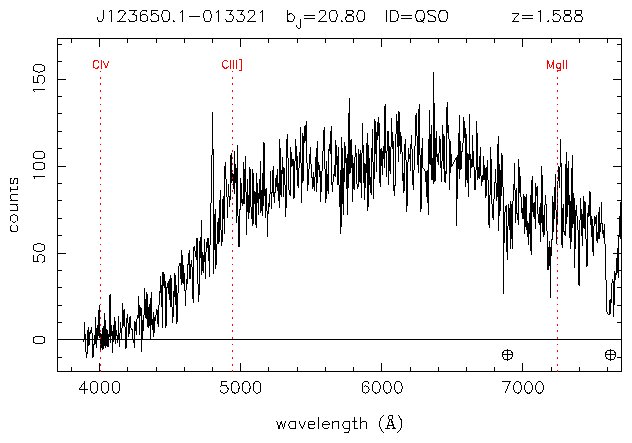
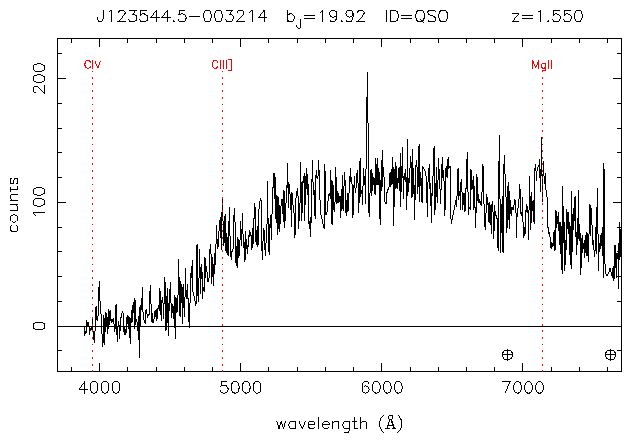
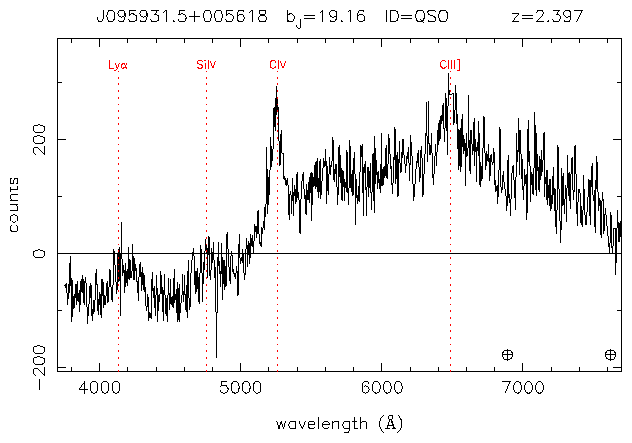
  <p>Three spectra were identified as potential forming galaxies, the
  first two may actually be galaxies in the foreground, and the third
  may potentially be a backlit DLA.</p>

  <dl>
   <dt><img src="graphs/J123650.1-013321a.gif" alt="J123650.1-013321a"/></dt>
   <dt><img src="graphs/J123544.5-003214a.gif" alt="J123544.5-003214a"/></dt>
   <dt><img src="graphs/J095931.5+005618b.gif" alt="J095931.5+005618b"/></dt>
  </dl>


   <p>The following spectra were also flagged. (Note that the data
   points are in the 0..1023 range of the data file, not in angstroms.)</p>

   <ul>
    <li>J012122.9-312825a may have a dip between data points 372 and 585.</li>
    <li>J024504.5-292103a may have a dip between data points 365 and 507.</li>
    <li>J110735.9-023414a may have a dip between data points 579 and 763.</li>
    <li>J113701.4-001940b may have a dip between data points 486 and 616.</li>
    <li>J124557.8+001757a may have a dip between data points 519 and 648.</li>
    <li>J124604.8+002714a may have a dip between data points 594 and 732.</li>
    <li>J131759.1+014012a may have a dip between data points 656 and 816.</li>
    <li>J134453.0-010637a may have a dip between data points 605 and 731.</li>
    <li>J143613.1-003657a may have a dip between data points 209 and 384.</li>
    <li>J215638.8-274941a may have a dip between data points 576 and 789.</li>
    <li>J222601.6-300959a may have a dip between data points 512 and 803.</li>
    <li>J224550.9-301903a may have a dip between data points 486 and 615.</li>
    <li>J230624.7-280338b may have a dip between data points 350 and 605.</li>
    <li>J235414.5-300225a may have a dip between data points 650 and 792.</li>
   </ul>

  <h4>2.5.2. Conclusions</h4>

  <p>In practice, this fails to take into the effects of fluctuations
  in the data. Even when ignoring a lot of high frequency noise (see
  the section on smoothing by fourier transform), this technique would
  still catch two high spikes around a low spike. The flagged spectra
  did not really fit the DLA profile.</p>

  <h3>2.6. Directions for future researh</h3>

  <p>These algorithms could be improved in two main ways. Firstly,
  instead of looking at mean values in the last algorithm, median
  values could be examined. This would reduce the sensitivity to peak
  noise.</p>

  <p>A second possible approach is to analyse the data in the
  frequency domain (technically the time domain, since the original
  data is a function of frequency) instead of examining the data after
  smoothing. This option was largely ignored during this analysis but
  could potentially lead to greater resilience against fluctuations.</p>

  <h2>3. The neural network approach</h2>

  <p>Neural networks are loosely based on what is believed to be the
  structure of human brains. Human brains are formed from large
  networks of neurons, cells that consist of many 'input' dendrites
  and many 'output' dendrites. Dendrites are interconnected by
  synapses, whose chemical state affects the weight with with the
  signal will impact the following neuron.</p>

  <p>To train the brain, it is believed that different responses
  trigger different chemicals to bathe the synapses, changing the
  relative impact of each dendrite on the next cell.</p>

  <p>In a real human brain there are roughly 10<sup>10</sup> neurons
  each with up to several thousand synapses contained on the
  dendrites, giving up to a maximum of 10<sup>14</sup> synapses
  [12].</p>

  <!--<p>Figure 1 from Bailer-Jones, Gupta &amp; Singh.</p>-->

  <p>Neural networks are similarly formed. The particular network type
  used in this investigation is known as a feed forward trilayer
  perceptron, using a back-propagating differential error correction
  algorithm for training.</p>

  <h3>3.1. Feed Forward Trilayer Perceptrons (FFTPs)</h3>

  <p>FFTPs are Feed Forward Multilayer Pereptrons (FFMPs) with two
  hidden layers. The implementation used here is based on the FFMP
  implementation discussed by Bailer-Jones, et al. [12]</p>

  <p>FFMPs are simple mathematical models of the biological neural
  networks described above. Neurons are replaced by transfer
  functions, dendrites are replaced by arrays, synapses by
  weights, and training chemicals by differentiation.</p>

  <p>Instead of a large network of cells all interconnected, a well
  defined number of layers is selected, and every combination of
  weights from the input layer to the first layer, the first layer to
  the second layer, and so on up to the output layer is then given a
  weight.</p>

  <!--<p>Figure 2 from Bailer-Jones, Gupta &amp; Singh.</p>-->

  <p>In addition to connections between every value of each layer to
  the next, an additional (arbitrary) value is connected to each value
  of each layer. These <dfn>bias nodes</dfn> are required to offset
  values. For example even if all the imputs are zero, the bias node
  allows the first layer to use non-zero values as arguments to the
  transfer function, allowoing the full range of output. Without bias
  nodes the only argument possible would be zero.</p>

  <h4>3.1.1. Transfer Function</h4>

  <p>The transfer function used is that recommended by Bailer-Jones,
  et al, namely the hyperbolic tangent.</p>

  <p>This function has the property that all real inputs give an
  output in the range of -1..1. However, it also introduces the
  possibility for network saturation, where the weights grow such that
  every node in a layer has the value 1 (or -1) and the data therefore
  has no relation to the input. This must be avoided by not
  over-training the network and by using small inital weights.</p>

  <h4>3.1.2. Equations</h4>

  <p class="note">The notation used here is based on that used by
  Bailer-Jones, et al.</p>

  <dl class="notation">
   <hacks:row>

    <dt><math xmlns="http://www.w3.org/1998/Math/MathML"> <msub>
    <mi>x</mi> <mi>i</mi> </msub> </math></dt>

    <dd>The input data. The <var>i</var> subscript's range is
    1..<var>I</var>+1, where <var>I</var> is the index of the last
    input node, so the <var>I</var>+1th node is the first hidden layer's
    bias node.</dd>

   </hacks:row>
   <hacks:row>

    <dt><math xmlns="http://www.w3.org/1998/Math/MathML"> <msub>
    <mi>p</mi> <mi>j</mi> </msub> </math></dt>

    <dd>The first hidden layer. The <var>j</var> subscript's range is
    1..<var>J</var>+1, where <var>J</var> is the index of the last node
    in the first hidden layer to be affected by the input layer, and
    the <var>J</var>+1th node is the second hidden layer's bias node.</dd>

   </hacks:row>
   <hacks:row>

    <dt><math xmlns="http://www.w3.org/1998/Math/MathML"> <msub>
    <mi>q</mi> <mi>k</mi> </msub> </math></dt>

    <dd>The second hidden layer. The <var>k</var> subscript's range is
    1..<var>K</var>+1, where <var>K</var> is the index of the last node
    in the second hidden layer to be affected by the first hidden
    layer, and the <var>K</var>+1th node is the output layer's bias
    node.</dd>

   </hacks:row>
   <hacks:row>

    <dt><math xmlns="http://www.w3.org/1998/Math/MathML"> <msub>
    <mi>y</mi> <mi>l</mi> </msub> </math></dt>

    <dd>The output layer. The <var>y</var> subscript's range is
    1..<var>L</var>, where <var>L</var> is the index of the last node
    in the output layer.</dd>

   </hacks:row>
   <hacks:row>

    <dt><math xmlns="http://www.w3.org/1998/Math/MathML"> <msub>
    <mi>w</mi> <mfenced open="" close=""> <mi>i</mi> <mi>j</mi>
    </mfenced> </msub> </math></dt>

    <dd>The weights between the <math
    xmlns="http://www.w3.org/1998/Math/MathML"> <msub> <mi>x</mi>
    <mrow> <mi>i</mi> <mo>..</mo> <mi>I</mi> <mo>+</mo> <mn>1</mn>
    </mrow> </msub> </math> and <math
    xmlns="http://www.w3.org/1998/Math/MathML"> <msub> <mi>p</mi>
    <mrow> <mi>j</mi> <mo>..</mo> <mi>J</mi> </mrow> </msub> </math>
    layers. </dd>

   </hacks:row>
   <hacks:row>

    <dt><math xmlns="http://www.w3.org/1998/Math/MathML"> <msub>
    <mi>w</mi> <mfenced open="" close=""> <mi>j</mi> <mi>k</mi>
    </mfenced> </msub> </math></dt>

    <dd>The weights between the <math
    xmlns="http://www.w3.org/1998/Math/MathML"> <msub> <mi>p</mi>
    <mrow> <mi>j</mi> <mo>..</mo> <mi>J</mi> <mo>+</mo> <mn>1</mn>
    </mrow> </msub> </math> and <math
    xmlns="http://www.w3.org/1998/Math/MathML"> <msub> <mi>q</mi>
    <mrow> <mi>k</mi> <mo>..</mo> <mi>K</mi>
    </mrow> </msub> </math> layers. </dd>

   </hacks:row>
   <hacks:row>

    <dt><math xmlns="http://www.w3.org/1998/Math/MathML"> <msub>
    <mi>w</mi> <mfenced open="" close=""> <mi>k</mi> <mi>l</mi>
    </mfenced> </msub> </math></dt>

    <dd>The weights between the <math
    xmlns="http://www.w3.org/1998/Math/MathML"> <msub> <mi>q</mi>
    <mrow> <mi>k</mi> <mo>..</mo> <mi>K</mi> <mo>+</mo> <mn>1</mn>
    </mrow> </msub> </math> and <math
    xmlns="http://www.w3.org/1998/Math/MathML"> <msub> <mi>y</mi>
    <mrow> <mi>l</mi> <mo>..</mo> <mi>L</mi> </mrow> </msub> </math>
    layers. </dd>

   </hacks:row>
  </dl>

  <p>The input layer is given by:</p>

  <p class="math" title="1">
   <math xmlns="http://www.w3.org/1998/Math/MathML">
    <mrow>
     <msub>
      <mi>x</mi>
      <mi>i</mi>
     </msub>
     <mo>=</mo>
     <mo>{</mo>
     <mtable>
      <mtr>
       <mtd>
        <mn>1</mn>
       </mtd>
       <mtd>
        <mi>i</mi>
        <mo>=</mo>
        <mi>I</mi>
        <mo>+</mo>
        <mn>1</mn>
       </mtd>
      </mtr>
      <mtr>
       <mtd>
        <mi>input</mi>
        <mo>&ApplyFunction;</mo>
        <mfenced>
         <mi>i</mi>
        </mfenced>
       </mtd>
       <mtd>
        <mtext>otherwise</mtext>
       </mtd>
      </mtr>
     </mtable>
    </mrow>
   </math>
  </p>

  <p>Each node in the first hidden layer is then calulated by summing
  each input (including the bias node) multiplied by a weighting
  value, and finding the hyperbolic tangent of the result:</p>

  <p class="math" title="2">
   <math xmlns="http://www.w3.org/1998/Math/MathML">
    <mrow>
     <msub>
      <mi>p</mi>
      <mi>j</mi>
     </msub>
     <mo>=</mo>
     <mo>{</mo>
     <mtable>
      <mtr>
       <mtd>
        <mn>1</mn>
       </mtd>
       <mtd>
        <mi>j</mi>
        <mo>=</mo>
        <mi>J</mi>
        <mo>+</mo>
        <mn>1</mn>
       </mtd>
      </mtr>
      <mtr>
       <mtd>
        <mi>tanh</mi>
        <mo>&ApplyFunction;</mo>
        <mfenced>
         <mrow>
          <munderover>
           <mi>&Sum;</mi>
           <msup><mi>i</mi><mo>&prime;</mo></msup>
           <mi>I</mi>
          </munderover>
          <msub>
           <mi>w</mi>
           <mfenced open="" close="">
            <msup><mi>i</mi><mo>&prime;</mo></msup>
            <mi>j</mi>
           </mfenced>
          </msub>
          <mo>&InvisibleTimes;</mo>
          <msub>
           <mi>x</mi>
           <msup><mi>i</mi><mo>&prime;</mo></msup>
          </msub>
          <mo>+</mo>
          <msub>
           <mi>w</mi>
           <mfenced open="" close="">
            <mrow>
             <mi>I</mi>
             <mo>+</mo>
             <mn>1</mn>
            </mrow>
            <mi>j</mi>
           </mfenced>
          </msub>
         </mrow>
        </mfenced>
       </mtd>
       <mtd>
        <mtext>otherwise</mtext>
       </mtd>
      </mtr>
     </mtable>
    </mrow>
   </math>
  </p>

  <p class="math" title="3">
   <math xmlns="http://www.w3.org/1998/Math/MathML">
    <mrow>
     <msub>
      <mi>q</mi>
      <mi>k</mi>
     </msub>
     <mo>=</mo>
     <mo>{</mo>
     <mtable>
      <mtr>
       <mtd>
        <mn>1</mn>
       </mtd>
       <mtd>
        <mi>k</mi>
        <mo>=</mo>
        <mi>K</mi>
        <mo>+</mo>
        <mn>1</mn>
       </mtd>
      </mtr>
      <mtr>
       <mtd>
        <mi>tanh</mi>
        <mo>&ApplyFunction;</mo>
        <mfenced>
         <mrow>
          <munderover>
           <mi>&Sum;</mi>
           <msup><mi>j</mi><mo>&prime;</mo></msup>
           <mi>J</mi>
          </munderover>
          <msub>
           <mi>w</mi>
           <mfenced open="" close="">
            <msup><mi>j</mi><mo>&prime;</mo></msup>
            <mi>k</mi>
           </mfenced>
          </msub>
          <mo>&InvisibleTimes;</mo>
          <msub>
           <mi>p</mi>
           <msup><mi>j</mi><mo>&prime;</mo></msup>
          </msub>
          <mo>+</mo>
          <msub>
           <mi>w</mi>
           <mfenced open="" close="">
            <mrow>
             <mi>J</mi>
             <mo>+</mo>
             <mn>1</mn>
            </mrow>
            <mi>k</mi>
           </mfenced>
          </msub>
         </mrow>
        </mfenced>
       </mtd>
       <mtd>
        <mtext>otherwise</mtext>
       </mtd>
      </mtr>
     </mtable>
    </mrow>
   </math>
  </p>

  <p class="math" title="4">
   <math xmlns="http://www.w3.org/1998/Math/MathML">
    <mrow>
     <msub>
      <mi>y</mi>
      <mi>l</mi>
     </msub>
     <mo>=</mo>
     <munderover>
      <mi>&Sum;</mi>
      <msup><mi>k</mi><mo>&prime;</mo></msup>
      <mi>K</mi>
     </munderover>
     <msub>
      <mi>w</mi>
      <mfenced open="" close="">
       <msup><mi>k</mi><mo>&prime;</mo></msup>
       <mi>l</mi>
      </mfenced>
     </msub>
     <mo>&InvisibleTimes;</mo>
     <msub>
      <mi>q</mi>
      <msup><mi>k</mi><mo>&prime;</mo></msup>
     </msub>
     <mo>+</mo>
     <msub>
      <mi>w</mi>
      <mfenced open="" close="">
       <mrow>
        <mi>K</mi>
        <mo>+</mo>
        <mn>1</mn>
       </mrow>
       <mi>l</mi>
      </mfenced>
     </msub>
    </mrow>
   </math>
  </p>

  <h3>3.2. Back-Propagating Differential Error Correction</h3>

  <p>The training consists of supervised learning by minimization of
  an error function with respect to all of the network weights. [12]
  The error function used here is the sum-of-squares error:</p>

  <p class="math" title="5">
   <math xmlns="http://www.w3.org/1998/Math/MathML">
    <mrow>
     <mi>e</mi>
     <mo>=</mo>
     <mfrac>
      <mn>1</mn>
      <mn>2</mn>
     </mfrac>
     <mo>&InvisibleTimes;</mo>
     <munderover>
      <mi>&Sum;</mi>
      <msup><mi>l</mi><mo>&prime;</mo></msup>
      <mi>L</mi>
     </munderover>
     <msub>
      <mi>&beta;</mi>
      <msup><mi>l</mi><mo>&prime;</mo></msup>
     </msub>
     <mo>&InvisibleTimes;</mo>
     <msup>
      <mfenced>
      <mrow> 
       <msub>
        <mi>y</mi>
        <msup><mi>l</mi><mo>&prime;</mo></msup>
       </msub>
       <mo>-</mo>
       <msub>
        <mi>T</mi>
        <msup><mi>l</mi><mo>&prime;</mo></msup>
       </msub>
      </mrow>
      </mfenced>
      <mn>2</mn>
     </msup>
    </mrow>
   </math>
  </p>

  <p>This represents the total difference between the actual output and
  the ideal output. By minimising this number we move towards a more
  ideal output, and by finding how much a small change in each weight
  would affect the error function, we can estimate how much change in
  the weights is required to move towards the minimum.</p>

  <p>For the last set of weights, differentiating equation 5 with
  respect to the weights gives:</p>

  <p class="math" title="6">
   <math xmlns="http://www.w3.org/1998/Math/MathML">
    <mrow>
     <mfrac>
      <mrow>
       <mo>&part;</mo>
       <mi>e</mi>
      </mrow>
      <mrow>
       <mo>&part;</mo>
       <msub>
        <mi>w</mi>
        <mfenced open="" close="">
         <mi>k</mi>
         <mi>l</mi>
        </mfenced>
       </msub>
      </mrow>
     </mfrac>
     <mo>=</mo>
     <mfrac>
      <mn>1</mn>
      <mn>2</mn>
     </mfrac>
     <mo>&InvisibleTimes;</mo>
     <munderover>
      <mi>&Sum;</mi>
      <msup><mi>l</mi><mo>&prime;</mo></msup>
      <mi>L</mi>
     </munderover>
     <msub>
      <mi>&beta;</mi>
      <msup><mi>l</mi><mo>&prime;</mo></msup>
     </msub>
     <mo>&InvisibleTimes;</mo>
     <mn>2</mn>
     <mo>&InvisibleTimes;</mo>
     <mfenced>
     <mrow> 
      <msub>
       <mi>y</mi>
       <msup><mi>l</mi><mo>&prime;</mo></msup>
      </msub>
      <mo>-</mo>
      <msub>
       <mi>T</mi>
       <msup><mi>l</mi><mo>&prime;</mo></msup>
      </msub>
     </mrow>
     </mfenced>
     <mo>&InvisibleTimes;</mo>
     <mfrac>
      <mrow>
       <mo>&part;</mo>
       <msub>
        <mi>y</mi>
        <mi>l</mi>
       </msub>
      </mrow>
      <mrow>
       <mo>&part;</mo>
       <msub>
        <mi>w</mi>
        <mfenced open="" close="">
         <mi>k</mi>
         <msup><mi>l</mi><mo>&prime;</mo></msup>
        </mfenced>
       </msub>
      </mrow>
     </mfrac>
    </mrow>
   </math>
  </p>

  <p>...where:</p>

  <p class="math" title="7">
   <math xmlns="http://www.w3.org/1998/Math/MathML">
    <mrow>
     <mfrac>
      <mrow>
       <mo>&part;</mo>
       <msub>
        <mi>y</mi>
        <msup><mi>l</mi><mo>&prime;</mo></msup>
       </msub>
      </mrow>
      <mrow>
       <mo>&part;</mo>
       <msub>
        <mi>w</mi>
        <mfenced open="" close="">
         <mi>k</mi>
         <mi>l</mi>
        </mfenced>
       </msub>
      </mrow>
     </mfrac>
     <mo>=</mo>
     <munderover>
      <mi>&Sum;</mi>
      <msup><mi>k</mi><mo>&prime;</mo></msup>
      <mi>K</mi>
     </munderover>
     <msub>
      <mi>&delta;</mi>
      <mrow>
       <msup><mi>k</mi><mo>&prime;</mo></msup>
       <mi>k</mi>
      </mrow>
     </msub>
     <mo>&InvisibleTimes;</mo>
     <msub>
      <mi>&delta;</mi>
      <mrow>
       <msup><mi>l</mi><mo>&prime;</mo></msup>
       <mi>l</mi>
      </mrow>
     </msub>
     <mo>&InvisibleTimes;</mo>
     <msub>
      <mi>q</mi>
      <msup><mi>k</mi><mo>&prime;</mo></msup>
     </msub>
     <mo>+</mo>
     <msub>
      <mi>&delta;</mi>
      <mrow>
       <mrow>
        <mi>K</mi>
        <mo>+</mo>
        <mn>1</mn>
       </mrow>
       <mi>k</mi>
      </mrow>
     </msub>
     <msub>
      <mi>&delta;</mi>
      <mrow>
       <msup><mi>l</mi><mo>&prime;</mo></msup>
       <mi>l</mi>
      </mrow>
     </msub>
    </mrow>
   </math>
  </p>

  <p>...and <math
  xmlns="http://www.w3.org/1998/Math/MathML"><mi>&delta;</mi></math>
  is the Kronecker delta function.</p>

  <p>This simplifies to:</p>

  <p class="math" title="8">
   <math xmlns="http://www.w3.org/1998/Math/MathML">
    <mrow>
     <mfrac>
      <mrow>
       <mo>&part;</mo>
       <msub>
        <mi>y</mi>
        <msup><mi>l</mi><mo>&prime;</mo></msup>
       </msub>
      </mrow>
      <mrow>
       <mo>&part;</mo>
       <msub>
        <mi>w</mi>
        <mfenced open="" close="">
         <mi>k</mi>
         <mi>l</mi>
        </mfenced>
       </msub>
      </mrow>
     </mfrac>
     <mo>=</mo>
     <mo>{</mo>
     <mtable>
      <mtr>
       <mtd>
        <msub>
         <mi>&delta;</mi>
         <mrow>
          <msup><mi>l</mi><mo>&prime;</mo></msup>
          <mi>l</mi>
         </mrow>
        </msub>
       </mtd>
       <mtd>
        <mi>k</mi>
        <mo>=</mo>
        <mi>K</mi>
        <mo>+</mo>
        <mn>1</mn>
       </mtd>
      </mtr>
      <mtr>
       <mtd>
        <msub>
         <mi>&delta;</mi>
         <mrow>
          <msup><mi>l</mi><mo>&prime;</mo></msup>
          <mi>l</mi>
         </mrow>
        </msub>
        <mo>&InvisibleTimes;</mo>
        <msub>
         <mi>q</mi>
         <mi>k</mi>
        </msub>
       </mtd>
       <mtd>
        <mtext>otherwise</mtext>
       </mtd>
      </mtr>
     </mtable>
    </mrow>
   </math>
  </p>

  <p>Substituting 8 into 6:</p>

  <p class="math" title="9">
   <math xmlns="http://www.w3.org/1998/Math/MathML">
    <mrow>
     <mfrac>
      <mrow>
       <mo>&part;</mo>
       <mi>e</mi>
      </mrow>
      <mrow>
       <mo>&part;</mo>
       <msub>
        <mi>w</mi>
        <mfenced open="" close="">
         <mi>k</mi>
         <mi>l</mi>
        </mfenced>
       </msub>
      </mrow>
     </mfrac>
     <mo>=</mo>
     <mo>{</mo>
     <mtable>
      <mtr>
       <mtd>

     <mfrac>
      <mn>1</mn>
      <mn>2</mn>
     </mfrac>
     <mo>&InvisibleTimes;</mo>
     <munderover>
      <mi>&Sum;</mi>
      <msup><mi>l</mi><mo>&prime;</mo></msup>
      <mi>L</mi>
     </munderover>
     <msub>
      <mi>&beta;</mi>
      <msup><mi>l</mi><mo>&prime;</mo></msup>
     </msub>
     <mo>&InvisibleTimes;</mo>
     <mn>2</mn>
     <mo>&InvisibleTimes;</mo>
     <mfenced>
     <mrow> 
      <msub>
       <mi>y</mi>
       <msup><mi>l</mi><mo>&prime;</mo></msup>
      </msub>
      <mo>-</mo>
      <msub>
       <mi>T</mi>
       <msup><mi>l</mi><mo>&prime;</mo></msup>
      </msub>
     </mrow>
     </mfenced>
     <mo>&InvisibleTimes;</mo>

        <msub>
         <mi>&delta;</mi>
         <mrow>
          <msup><mi>l</mi><mo>&prime;</mo></msup>
          <mi>l</mi>
         </mrow>
        </msub>
       </mtd>
       <mtd>
        <mi>k</mi>
        <mo>=</mo>
        <mi>K</mi>
        <mo>+</mo>
        <mn>1</mn>
       </mtd>
      </mtr>
      <mtr>
       <mtd>

     <mfrac>
      <mn>1</mn>
      <mn>2</mn>
     </mfrac>
     <mo>&InvisibleTimes;</mo>
     <munderover>
      <mi>&Sum;</mi>
      <msup><mi>l</mi><mo>&prime;</mo></msup>
      <mi>L</mi>
     </munderover>
     <msub>
      <mi>&beta;</mi>
      <msup><mi>l</mi><mo>&prime;</mo></msup>
     </msub>
     <mo>&InvisibleTimes;</mo>
     <mn>2</mn>
     <mo>&InvisibleTimes;</mo>
     <mfenced>
     <mrow> 
      <msub>
       <mi>y</mi>
       <msup><mi>l</mi><mo>&prime;</mo></msup>
      </msub>
      <mo>-</mo>
      <msub>
       <mi>T</mi>
       <msup><mi>l</mi><mo>&prime;</mo></msup>
      </msub>
     </mrow>
     </mfenced>
     <mo>&InvisibleTimes;</mo>

        <msub>
         <mi>&delta;</mi>
         <mrow>
          <msup><mi>l</mi><mo>&prime;</mo></msup>
          <mi>l</mi>
         </mrow>
        </msub>
        <mo>&InvisibleTimes;</mo>
        <msub>
         <mi>q</mi>
         <mi>k</mi>
        </msub>

       </mtd>
       <mtd>
        <mtext>otherwise</mtext>
       </mtd>
      </mtr>
     </mtable>
    </mrow>
   </math>
  </p>

  <p>...this simplifies to:</p>

  <p class="math" title="10">
   <math xmlns="http://www.w3.org/1998/Math/MathML">
    <mrow>
     <mfrac>
      <mrow>
       <mo>&part;</mo>
       <mi>e</mi>
      </mrow>
      <mrow>
       <mo>&part;</mo>
       <msub>
        <mi>w</mi>
        <mfenced open="" close="">
         <mi>k</mi>
         <mi>l</mi>
        </mfenced>
       </msub>
      </mrow>
     </mfrac>
     <mo>=</mo>
     <mo>{</mo>
     <mtable>
      <mtr>
       <mtd>
     <msub>
      <mi>&beta;</mi>
      <mi>l</mi>
     </msub>
     <mo>&InvisibleTimes;</mo>
     <mfenced>
     <mrow> 
      <msub>
       <mi>y</mi>
       <mi>l</mi>
      </msub>
      <mo>-</mo>
      <msub>
       <mi>T</mi>
       <mi>l</mi>
      </msub>
     </mrow>
     </mfenced>
     <mo>&InvisibleTimes;</mo>

       </mtd>
       <mtd>
        <mi>k</mi>
        <mo>=</mo>
        <mi>K</mi>
        <mo>+</mo>
        <mn>1</mn>
       </mtd>
      </mtr>
      <mtr>
       <mtd>
     <msub>
      <mi>&beta;</mi>
      <mi>l</mi>
     </msub>
     <mo>&InvisibleTimes;</mo>
     <mfenced>
     <mrow> 
      <msub>
       <mi>y</mi>
       <mi>l</mi>
      </msub>
      <mo>-</mo>
      <msub>
       <mi>T</mi>
       <mi>l</mi>
      </msub>
     </mrow>
     </mfenced>
     <mo>&InvisibleTimes;</mo>

        <msub>
         <mi>q</mi>
         <mi>k</mi>
        </msub>

       </mtd>
       <mtd>
        <mtext>otherwise</mtext>
       </mtd>
      </mtr>
     </mtable>
    </mrow>
   </math>
  </p>

  <p>For the middle set of weights,</p>

  <p class="math" title="11">
   <math xmlns="http://www.w3.org/1998/Math/MathML">
    <mrow>
     <mfrac>
      <mrow>
       <mo>&part;</mo>
       <mi>e</mi>
      </mrow>
      <mrow>
       <mo>&part;</mo>
       <msub>
        <mi>w</mi>
        <mfenced open="" close="">
         <mi>j</mi>
         <mi>k</mi>
        </mfenced>
       </msub>
      </mrow>
     </mfrac>
     <mo>=</mo>
     <mfrac>
      <mn>1</mn>
      <mn>2</mn>
     </mfrac>
     <mo>&InvisibleTimes;</mo>
     <munderover>
      <mi>&Sum;</mi>
      <msup><mi>l</mi><mo>&prime;</mo></msup>
      <mi>L</mi>
     </munderover>
     <msub>
      <mi>&beta;</mi>
      <msup><mi>l</mi><mo>&prime;</mo></msup>
     </msub>
     <mo>&InvisibleTimes;</mo>
     <mn>2</mn>
     <mo>&InvisibleTimes;</mo>
     <mfenced>
     <mrow> 
      <msub>
       <mi>y</mi>
       <msup><mi>l</mi><mo>&prime;</mo></msup>
      </msub>
      <mo>-</mo>
      <msub>
       <mi>T</mi>
       <msup><mi>l</mi><mo>&prime;</mo></msup>
      </msub>
     </mrow>
     </mfenced>
     <mo>&InvisibleTimes;</mo>
     <mfrac>
      <mrow>
       <mo>&part;</mo>
       <msub>
        <mi>y</mi>
        <msup><mi>l</mi><mo>&prime;</mo></msup>
       </msub>
      </mrow>
      <mrow>
       <mo>&part;</mo>
       <msub>
        <mi>w</mi>
        <mfenced open="" close="">
         <mi>j</mi>
         <mi>k</mi>
        </mfenced>
       </msub>
      </mrow>
     </mfrac>
    </mrow>
   </math>
  </p>

  <p>...where:</p>

  <p class="math" title="12">
   <math xmlns="http://www.w3.org/1998/Math/MathML">
    <mrow>
     <mfrac>
      <mrow>
       <mo>&part;</mo>
       <msub>
        <mi>y</mi>
        <msup><mi>l</mi><mo>&prime;</mo></msup>
       </msub>
      </mrow>
      <mrow>
       <mo>&part;</mo>
       <msub>
        <mi>w</mi>
        <mfenced open="" close="">
         <mi>j</mi>
         <mi>k</mi>
        </mfenced>
       </msub>
      </mrow>
     </mfrac>
     <mo>=</mo>
     <munderover>
      <mi>&Sum;</mi>
      <msup><mi>k</mi><mo>&prime;</mo></msup>
      <mi>K</mi>
     </munderover>
     <msub>
      <mi>w</mi>
      <mfenced open="" close="">
       <msup><mi>k</mi><mo>&prime;</mo></msup>
       <msup><mi>l</mi><mo>&prime;</mo></msup>
      </mfenced>
     </msub>
          <mo>&InvisibleTimes;</mo>

     <mfrac>
      <mrow>
       <mo>&part;</mo>
       <msub>
        <mi>q</mi>
        <msup><mi>k</mi><mo>&prime;</mo></msup>
       </msub>
      </mrow>
      <mrow>
       <mo>&part;</mo>
       <msub>
        <mi>w</mi>
        <mfenced open="" close="">
         <mi>j</mi>
         <mi>k</mi>
        </mfenced>
       </msub>
      </mrow>
     </mfrac>

    </mrow>
   </math>
  </p>


  <p class="math" title="13"> 
   <math xmlns="http://www.w3.org/1998/Math/MathML">
    <mrow>
     <mfrac>
      <mrow>
       <mo>&part;</mo>
       <msub>
        <mi>q</mi>
        <msup><mi>k</mi><mo>&prime;</mo></msup>
       </msub>
      </mrow>
      <mrow>
       <mo>&part;</mo>
       <msub>
        <mi>w</mi>
        <mfenced open="" close="">
         <mi>j</mi>
         <mi>k</mi>
        </mfenced>
       </msub>
      </mrow>
     </mfrac>
     <mo>=</mo>
     <mo>{</mo>
     <mtable>
      <mtr>
       <mtd>
        <mn>0</mn>
       </mtd>
       <mtd>
        <msup><mi>k</mi><mo>&prime;</mo></msup>
        <mo>=</mo>
        <mi>K</mi>
        <mo>+</mo>
        <mn>1</mn>
       </mtd>
      </mtr>
      <mtr>
       <mtd>
        <msup>
         <mi>sech</mi>
         <mn>2</mn>
        </msup>
        <mo>&ApplyFunction;</mo>
        <mfenced>
         <mrow>
          <munderover>
           <mi>&Sum;</mi>
           <msup><mi>j</mi><mo>&prime;</mo></msup>
           <mi>J</mi>
          </munderover>
          <msub>
           <mi>w</mi>
           <mfenced open="" close="">
            <msup><mi>j</mi><mo>&prime;</mo></msup>
            <msup><mi>k</mi><mo>&prime;</mo></msup>
           </mfenced>
          </msub>
          <mo>&InvisibleTimes;</mo>
          <msub>
           <mi>p</mi>
           <msup><mi>j</mi><mo>&prime;</mo></msup>
          </msub>
          <mo>+</mo>
          <msub>
           <mi>w</mi>
           <mfenced open="" close="">
            <mrow>
             <mi>J</mi>
             <mo>+</mo>
             <mn>1</mn>
            </mrow>
            <msup><mi>k</mi><mo>&prime;</mo></msup>
           </mfenced>
          </msub>
         </mrow>
        </mfenced>
          <mo>&InvisibleTimes;</mo>
        <mfenced>
         <mrow>
          <munderover>
           <mi>&Sum;</mi>
           <msup><mi>j</mi><mo>&prime;</mo></msup>
           <mi>J</mi>
          </munderover>

     <msub>
      <mi>&delta;</mi>
      <mrow>
       <msup><mi>j</mi><mo>&prime;</mo></msup>
       <mi>j</mi>
      </mrow>
     </msub>

          <mo>&InvisibleTimes;</mo>

     <msub>
      <mi>&delta;</mi>
      <mrow>
       <msup><mi>k</mi><mo>&prime;</mo></msup>
       <mi>k</mi>
      </mrow>
     </msub>

          <mo>&InvisibleTimes;</mo>
          <msub>
           <mi>p</mi>
           <msup><mi>j</mi><mo>&prime;</mo></msup>
          </msub>
          <mo>+</mo>

     <msub>
      <mi>&delta;</mi>
      <mrow>
            <mrow>
             <mi>J</mi>
             <mo>+</mo>
             <mn>1</mn>
            </mrow>
       <mi>j</mi>
      </mrow>
     </msub>

          <mo>&InvisibleTimes;</mo>

     <msub>
      <mi>&delta;</mi>
      <mrow>
       <msup><mi>k</mi><mo>&prime;</mo></msup>
       <mi>k</mi>
      </mrow>
     </msub>
         </mrow>
        </mfenced>
       </mtd>
       <mtd>
        <mtext>otherwise</mtext>
       </mtd>
      </mtr>
     </mtable>
    </mrow>
   </math>
  </p>


  <p>Simplifying:</p>

  <p class="math" title="14">
   <math xmlns="http://www.w3.org/1998/Math/MathML">
    <mrow>
     <mfrac>
      <mrow>
       <mo>&part;</mo>
       <msub>
        <mi>q</mi>
        <msup><mi>k</mi><mo>&prime;</mo></msup>
       </msub>
      </mrow>
      <mrow>
       <mo>&part;</mo>
       <msub>
        <mi>w</mi>
        <mfenced open="" close="">
         <mi>j</mi>
         <mi>k</mi>
        </mfenced>
       </msub>
      </mrow>
     </mfrac>
     <mo>=</mo>
     <mo>{</mo>

     <mtable>

      <mtr>
       <mtd>
        <mn>0</mn>
       </mtd>
       <mtd>
        <msup><mi>k</mi><mo>&prime;</mo></msup>
        <mo>=</mo>
        <mi>K</mi>
        <mo>+</mo>
        <mn>1</mn>
       </mtd>
      </mtr>


      <mtr>
       <mtd>
        <msup>
         <mi>sech</mi>
         <mn>2</mn>
        </msup>
        <mo>&ApplyFunction;</mo>
        <mfenced>
         <mrow>
          <munderover>
           <mi>&Sum;</mi>
           <msup><mi>j</mi><mo>&prime;</mo></msup>
           <mi>J</mi>
          </munderover>
          <msub>
           <mi>w</mi>
           <mfenced open="" close="">
            <msup><mi>j</mi><mo>&prime;</mo></msup>
            <msup><mi>k</mi><mo>&prime;</mo></msup>
           </mfenced>
          </msub>
          <mo>&InvisibleTimes;</mo>
          <msub>
           <mi>p</mi>
           <msup><mi>j</mi><mo>&prime;</mo></msup>
          </msub>
          <mo>+</mo>
          <msub>
           <mi>w</mi>
           <mfenced open="" close="">
            <mrow>
             <mi>J</mi>
             <mo>+</mo>
             <mn>1</mn>
            </mrow>
            <msup><mi>k</mi><mo>&prime;</mo></msup>
           </mfenced>
          </msub>
         </mrow>
        </mfenced>
          <mo>&InvisibleTimes;</mo>

     <msub>
      <mi>&delta;</mi>
      <mrow>
       <msup><mi>k</mi><mo>&prime;</mo></msup>
       <mi>k</mi>
      </mrow>
     </msub>

       </mtd>
       <mtd>
        <mi>j</mi>
        <mo>=</mo>
        <mi>J</mi>
        <mo>+</mo>
        <mn>1</mn>

       </mtd>
      </mtr>

      <mtr>
       <mtd>
        <msup>
         <mi>sech</mi>
         <mn>2</mn>
        </msup>
        <mo>&ApplyFunction;</mo>
        <mfenced>
         <mrow>
          <munderover>
           <mi>&Sum;</mi>
           <msup><mi>j</mi><mo>&prime;</mo></msup>
           <mi>J</mi>
          </munderover>
          <msub>
           <mi>w</mi>
           <mfenced open="" close="">
            <msup><mi>j</mi><mo>&prime;</mo></msup>
            <msup><mi>k</mi><mo>&prime;</mo></msup>
           </mfenced>
          </msub>
          <mo>&InvisibleTimes;</mo>
          <msub>
           <mi>p</mi>
           <msup><mi>j</mi><mo>&prime;</mo></msup>
          </msub>
          <mo>+</mo>
          <msub>
           <mi>w</mi>
           <mfenced open="" close="">
            <mrow>
             <mi>J</mi>
             <mo>+</mo>
             <mn>1</mn>
            </mrow>
            <msup><mi>k</mi><mo>&prime;</mo></msup>
           </mfenced>
          </msub>
         </mrow>
        </mfenced>
          <mo>&InvisibleTimes;</mo>
     <msub>
      <mi>&delta;</mi>
      <mrow>
       <msup><mi>k</mi><mo>&prime;</mo></msup>
       <mi>k</mi>
      </mrow>
     </msub>
          <mo>&InvisibleTimes;</mo>
          <msub>
           <mi>p</mi>
           <mi>j</mi>
          </msub>
       </mtd>
       <mtd>
        <mtext>otherwise</mtext>
       </mtd>
      </mtr>
     </mtable>
    </mrow>
   </math>
  </p>

  <p>Substituting 14 into 12, and noting the sum over <math
  xmlns="http://www.w3.org/1998/Math/MathML"><msup><mi>k</mi><mo>&prime;</mo></msup></math>
  does not exceed <var>K</var>:</p>

  <p class="math" title="15">
   <math xmlns="http://www.w3.org/1998/Math/MathML">
    <mrow>
     <mfrac>
      <mrow>
       <mo>&part;</mo>
       <msub>
        <mi>y</mi>
        <msup><mi>l</mi><mo>&prime;</mo></msup>
       </msub>
      </mrow>
      <mrow>
       <mo>&part;</mo>
       <msub>
        <mi>w</mi>
        <mfenced open="" close="">
         <mi>j</mi>
         <mi>k</mi>
        </mfenced>
       </msub>
      </mrow>
     </mfrac>
     <mo>=</mo>
     <mo>{</mo>

     <mtable>
      <mtr>
       <mtd>
     <munderover>
      <mi>&Sum;</mi>
      <msup><mi>k</mi><mo>&prime;</mo></msup>
      <mi>K</mi>
     </munderover>
     <msub>
      <mi>w</mi>
      <mfenced open="" close="">
       <msup><mi>k</mi><mo>&prime;</mo></msup>
       <msup><mi>l</mi><mo>&prime;</mo></msup>
      </mfenced>
     </msub>
          <mo>&InvisibleTimes;</mo>
        <msup>
         <mi>sech</mi>
         <mn>2</mn>
        </msup>
        <mo>&ApplyFunction;</mo>
        <mfenced>
         <mrow>
          <munderover>
           <mi>&Sum;</mi>
           <msup><mi>j</mi><mo>&prime;</mo></msup>
           <mi>J</mi>
          </munderover>
          <msub>
           <mi>w</mi>
           <mfenced open="" close="">
            <msup><mi>j</mi><mo>&prime;</mo></msup>
            <msup><mi>k</mi><mo>&prime;</mo></msup>
           </mfenced>
          </msub>
          <mo>&InvisibleTimes;</mo>
          <msub>
           <mi>p</mi>
           <msup><mi>j</mi><mo>&prime;</mo></msup>
          </msub>
          <mo>+</mo>
          <msub>
           <mi>w</mi>
           <mfenced open="" close="">
            <mrow>
             <mi>J</mi>
             <mo>+</mo>
             <mn>1</mn>
            </mrow>
            <msup><mi>k</mi><mo>&prime;</mo></msup>
           </mfenced>
          </msub>
         </mrow>
        </mfenced>
          <mo>&InvisibleTimes;</mo>

     <msub>
      <mi>&delta;</mi>
      <mrow>
       <msup><mi>k</mi><mo>&prime;</mo></msup>
       <mi>k</mi>
      </mrow>
     </msub>

       </mtd>
       <mtd>
        <mi>j</mi>
        <mo>=</mo>
        <mi>J</mi>
        <mo>+</mo>
        <mn>1</mn>

       </mtd>
      </mtr>

      <mtr>
       <mtd>
     <munderover>
      <mi>&Sum;</mi>
      <msup><mi>k</mi><mo>&prime;</mo></msup>
      <mi>K</mi>
     </munderover>
     <msub>
      <mi>w</mi>
      <mfenced open="" close="">
       <msup><mi>k</mi><mo>&prime;</mo></msup>
       <msup><mi>l</mi><mo>&prime;</mo></msup>
      </mfenced>
     </msub>
          <mo>&InvisibleTimes;</mo>
        <msup>
         <mi>sech</mi>
         <mn>2</mn>
        </msup>
        <mo>&ApplyFunction;</mo>
        <mfenced>
         <mrow>
          <munderover>
           <mi>&Sum;</mi>
           <msup><mi>j</mi><mo>&prime;</mo></msup>
           <mi>J</mi>
          </munderover>
          <msub>
           <mi>w</mi>
           <mfenced open="" close="">
            <msup><mi>j</mi><mo>&prime;</mo></msup>
            <msup><mi>k</mi><mo>&prime;</mo></msup>
           </mfenced>
          </msub>
          <mo>&InvisibleTimes;</mo>
          <msub>
           <mi>p</mi>
           <msup><mi>j</mi><mo>&prime;</mo></msup>
          </msub>
          <mo>+</mo>
          <msub>
           <mi>w</mi>
           <mfenced open="" close="">
            <mrow>
             <mi>J</mi>
             <mo>+</mo>
             <mn>1</mn>
            </mrow>
            <msup><mi>k</mi><mo>&prime;</mo></msup>
           </mfenced>
          </msub>
         </mrow>
        </mfenced>
          <mo>&InvisibleTimes;</mo>
     <msub>
      <mi>&delta;</mi>
      <mrow>
       <msup><mi>k</mi><mo>&prime;</mo></msup>
       <mi>k</mi>
      </mrow>
     </msub>
          <mo>&InvisibleTimes;</mo>
          <msub>
           <mi>p</mi>
           <mi>j</mi>
          </msub>
       </mtd>
       <mtd>
        <mtext>otherwise</mtext>
       </mtd>
      </mtr>
     </mtable>
    </mrow>
   </math>
  </p>

  <p>Simplifying:</p>

  <p class="math" title="16">
   <math xmlns="http://www.w3.org/1998/Math/MathML">
    <mrow>
     <mfrac>
      <mrow>
       <mo>&part;</mo>
       <msub>
        <mi>y</mi>
        <msup><mi>l</mi><mo>&prime;</mo></msup>
       </msub>
      </mrow>
      <mrow>
       <mo>&part;</mo>
       <msub>
        <mi>w</mi>
        <mfenced open="" close="">
         <mi>j</mi>
         <mi>k</mi>
        </mfenced>
       </msub>
      </mrow>
     </mfrac>
     <mo>=</mo>
     <mo>{</mo>

     <mtable>
      <mtr>
       <mtd>

     <msub>
      <mi>w</mi>
      <mfenced open="" close="">
       <mi>k</mi>
       <msup><mi>l</mi><mo>&prime;</mo></msup>
      </mfenced>
     </msub>
          <mo>&InvisibleTimes;</mo>
        <msup>
         <mi>sech</mi>
         <mn>2</mn>
        </msup>
        <mo>&ApplyFunction;</mo>
        <mfenced>
         <mrow>
          <munderover>
           <mi>&Sum;</mi>
           <msup><mi>j</mi><mo>&prime;</mo></msup>
           <mi>J</mi>
          </munderover>
          <msub>
           <mi>w</mi>
           <mfenced open="" close="">
            <msup><mi>j</mi><mo>&prime;</mo></msup>
            <mi>k</mi>
           </mfenced>
          </msub>
          <mo>&InvisibleTimes;</mo>
          <msub>
           <mi>p</mi>
           <msup><mi>j</mi><mo>&prime;</mo></msup>
          </msub>
          <mo>+</mo>
          <msub>
           <mi>w</mi>
           <mfenced open="" close="">
            <mrow>
             <mi>J</mi>
             <mo>+</mo>
             <mn>1</mn>
            </mrow>
            <mi>k</mi>
           </mfenced>
          </msub>
         </mrow>
        </mfenced>

       </mtd>
       <mtd>
        <mi>j</mi>
        <mo>=</mo>
        <mi>J</mi>
        <mo>+</mo>
        <mn>1</mn>

       </mtd>
      </mtr>

      <mtr>
       <mtd>
     <msub>
      <mi>w</mi>
      <mfenced open="" close="">
       <mi>k</mi>
       <msup><mi>l</mi><mo>&prime;</mo></msup>
      </mfenced>
     </msub>
          <mo>&InvisibleTimes;</mo>
        <msup>
         <mi>sech</mi>
         <mn>2</mn>
        </msup>
        <mo>&ApplyFunction;</mo>
        <mfenced>
         <mrow>
          <munderover>
           <mi>&Sum;</mi>
           <msup><mi>j</mi><mo>&prime;</mo></msup>
           <mi>J</mi>
          </munderover>
          <msub>
           <mi>w</mi>
           <mfenced open="" close="">
            <msup><mi>j</mi><mo>&prime;</mo></msup>
            <mi>k</mi>
           </mfenced>
          </msub>
          <mo>&InvisibleTimes;</mo>
          <msub>
           <mi>p</mi>
           <msup><mi>j</mi><mo>&prime;</mo></msup>
          </msub>
          <mo>+</mo>
          <msub>
           <mi>w</mi>
           <mfenced open="" close="">
            <mrow>
             <mi>J</mi>
             <mo>+</mo>
             <mn>1</mn>
            </mrow>
            <mi>k</mi>
           </mfenced>
          </msub>
         </mrow>
        </mfenced>
          <mo>&InvisibleTimes;</mo>
          <msub>
           <mi>p</mi>
           <mi>j</mi>
          </msub>
       </mtd>
       <mtd>
        <mtext>otherwise</mtext>
       </mtd>
      </mtr>
     </mtable>
    </mrow>
   </math>
  </p>

  <p>Substituting 16 into 11 and cancelling the twos:</p>

  <p class="math" title="17">
   <math xmlns="http://www.w3.org/1998/Math/MathML">
    <mrow>
     <mfrac>
      <mrow>
       <mo>&part;</mo>
       <mi>e</mi>
      </mrow>
      <mrow>
       <mo>&part;</mo>
       <msub>
        <mi>w</mi>
        <mfenced open="" close="">
         <mi>j</mi>
         <mi>k</mi>
        </mfenced>
       </msub>
      </mrow>
     </mfrac>
     <mo>=</mo>
     <mo>{</mo>

     <mtable>
      <mtr>
       <mtd>
     <munderover>
      <mi>&Sum;</mi>
      <msup><mi>l</mi><mo>&prime;</mo></msup>
      <mi>L</mi>
     </munderover>
     <msub>
      <mi>&beta;</mi>
      <msup><mi>l</mi><mo>&prime;</mo></msup>
     </msub>
     <mo>&InvisibleTimes;</mo>
     <mfenced>
     <mrow> 
      <msub>
       <mi>y</mi>
       <msup><mi>l</mi><mo>&prime;</mo></msup>
      </msub>
      <mo>-</mo>
      <msub>
       <mi>T</mi>
       <msup><mi>l</mi><mo>&prime;</mo></msup>
      </msub>
     </mrow>
     </mfenced>
     <mo>&InvisibleTimes;</mo>

     <msub>
      <mi>w</mi>
      <mfenced open="" close="">
       <mi>k</mi>
       <msup><mi>l</mi><mo>&prime;</mo></msup>
      </mfenced>
     </msub>
          <mo>&InvisibleTimes;</mo>
        <msup>
         <mi>sech</mi>
         <mn>2</mn>
        </msup>
        <mo>&ApplyFunction;</mo>
        <mfenced>
         <mrow>
          <munderover>
           <mi>&Sum;</mi>
           <msup><mi>j</mi><mo>&prime;</mo></msup>
           <mi>J</mi>
          </munderover>
          <msub>
           <mi>w</mi>
           <mfenced open="" close="">
            <msup><mi>j</mi><mo>&prime;</mo></msup>
            <mi>k</mi>
           </mfenced>
          </msub>
          <mo>&InvisibleTimes;</mo>
          <msub>
           <mi>p</mi>
           <msup><mi>j</mi><mo>&prime;</mo></msup>
          </msub>
          <mo>+</mo>
          <msub>
           <mi>w</mi>
           <mfenced open="" close="">
            <mrow>
             <mi>J</mi>
             <mo>+</mo>
             <mn>1</mn>
            </mrow>
            <mi>k</mi>
           </mfenced>
          </msub>
         </mrow>
        </mfenced>

       </mtd>
       <mtd>
        <mi>j</mi>
        <mo>=</mo>
        <mi>J</mi>
        <mo>+</mo>
        <mn>1</mn>

       </mtd>
      </mtr>

      <mtr>
       <mtd>
     <munderover>
      <mi>&Sum;</mi>
      <msup><mi>l</mi><mo>&prime;</mo></msup>
      <mi>L</mi>
     </munderover>
     <msub>
      <mi>&beta;</mi>
      <msup><mi>l</mi><mo>&prime;</mo></msup>
     </msub>

     <mo>&InvisibleTimes;</mo>
     <mfenced>
     <mrow> 
      <msub>
       <mi>y</mi>
       <msup><mi>l</mi><mo>&prime;</mo></msup>
      </msub>
      <mo>-</mo>
      <msub>
       <mi>T</mi>
       <msup><mi>l</mi><mo>&prime;</mo></msup>
      </msub>
     </mrow>
     </mfenced>
     <mo>&InvisibleTimes;</mo>

     <msub>
      <mi>w</mi>
      <mfenced open="" close="">
       <mi>k</mi>
       <msup><mi>l</mi><mo>&prime;</mo></msup>
      </mfenced>
     </msub>
          <mo>&InvisibleTimes;</mo>
        <msup>
         <mi>sech</mi>
         <mn>2</mn>
        </msup>
        <mo>&ApplyFunction;</mo>
        <mfenced>
         <mrow>
          <munderover>
           <mi>&Sum;</mi>
           <msup><mi>j</mi><mo>&prime;</mo></msup>
           <mi>J</mi>
          </munderover>
          <msub>
           <mi>w</mi>
           <mfenced open="" close="">
            <msup><mi>j</mi><mo>&prime;</mo></msup>
            <mi>k</mi>
           </mfenced>
          </msub>
          <mo>&InvisibleTimes;</mo>
          <msub>
           <mi>p</mi>
           <msup><mi>j</mi><mo>&prime;</mo></msup>
          </msub>
          <mo>+</mo>
          <msub>
           <mi>w</mi>
           <mfenced open="" close="">
            <mrow>
             <mi>J</mi>
             <mo>+</mo>
             <mn>1</mn>
            </mrow>
            <mi>k</mi>
           </mfenced>
          </msub>
         </mrow>
        </mfenced>
          <mo>&InvisibleTimes;</mo>
          <msub>
           <mi>p</mi>
           <mi>j</mi>
          </msub>
       </mtd>
       <mtd>
        <mtext>otherwise</mtext>
       </mtd>
      </mtr>
     </mtable>
    </mrow>
   </math>
  </p>


  <p>Finally for the first set of weights,</p>

  <p class="math" title="18">
   <math xmlns="http://www.w3.org/1998/Math/MathML">
    <mrow>
     <mfrac>
      <mrow>
       <mo>&part;</mo>
       <mi>e</mi>
      </mrow>
      <mrow>
       <mo>&part;</mo>
       <msub>
        <mi>w</mi>
        <mfenced open="" close="">
         <mi>i</mi>
         <mi>j</mi>
        </mfenced>
       </msub>
      </mrow>
     </mfrac>
     <mo>=</mo>
     <mfrac>
      <mn>1</mn>
      <mn>2</mn>
     </mfrac>
     <mo>&InvisibleTimes;</mo>
     <munderover>
      <mi>&Sum;</mi>
      <msup><mi>l</mi><mo>&prime;</mo></msup>
      <mi>L</mi>
     </munderover>
     <msub>
      <mi>&beta;</mi>
      <msup><mi>l</mi><mo>&prime;</mo></msup>
     </msub>
     <mo>&InvisibleTimes;</mo>
     <mn>2</mn>
     <mo>&InvisibleTimes;</mo>
     <mfenced>
     <mrow> 
      <msub>
       <mi>y</mi>
       <msup><mi>l</mi><mo>&prime;</mo></msup>
      </msub>
      <mo>-</mo>
      <msub>
       <mi>T</mi>
       <msup><mi>l</mi><mo>&prime;</mo></msup>
      </msub>
     </mrow>
     </mfenced>
     <mo>&InvisibleTimes;</mo>
     <mfrac>
      <mrow>
       <mo>&part;</mo>
       <msub>
        <mi>y</mi>
        <msup><mi>l</mi><mo>&prime;</mo></msup>
       </msub>
      </mrow>
      <mrow>
       <mo>&part;</mo>
       <msub>
        <mi>w</mi>
        <mfenced open="" close="">
         <mi>i</mi>
         <mi>j</mi>
        </mfenced>
       </msub>
      </mrow>
     </mfrac>
    </mrow>
   </math>
  </p>

  <p>...where:</p>

  <p class="math" title="19">
   <math xmlns="http://www.w3.org/1998/Math/MathML">
    <mrow>
     <mfrac>
      <mrow>
       <mo>&part;</mo>
       <msub>
        <mi>y</mi>
        <msup><mi>l</mi><mo>&prime;</mo></msup>
       </msub>
      </mrow>
      <mrow>
       <mo>&part;</mo>
       <msub>
        <mi>w</mi>
        <mfenced open="" close="">
         <mi>i</mi>
         <mi>j</mi>
        </mfenced>
       </msub>
      </mrow>
     </mfrac>
     <mo>=</mo>
     <munderover>
      <mi>&Sum;</mi>
      <msup><mi>k</mi><mo>&prime;</mo></msup>
      <mi>K</mi>
     </munderover>
     <msub>
      <mi>w</mi>
      <mfenced open="" close="">
       <msup><mi>k</mi><mo>&prime;</mo></msup>
       <msup><mi>l</mi><mo>&prime;</mo></msup>
      </mfenced>
     </msub>
          <mo>&InvisibleTimes;</mo>

     <mfrac>
      <mrow>
       <mo>&part;</mo>
       <msub>
        <mi>q</mi>
        <msup><mi>k</mi><mo>&prime;</mo></msup>
       </msub>
      </mrow>
      <mrow>
       <mo>&part;</mo>
       <msub>
        <mi>w</mi>
        <mfenced open="" close="">
         <mi>i</mi>
         <mi>j</mi>
        </mfenced>
       </msub>
      </mrow>
     </mfrac>

    </mrow>
   </math>
  </p>


  <p class="math" title="20"> 
   <math xmlns="http://www.w3.org/1998/Math/MathML">
    <mrow>
     <mfrac>
      <mrow>
       <mo>&part;</mo>
       <msub>
        <mi>q</mi>
        <msup><mi>k</mi><mo>&prime;</mo></msup>
       </msub>
      </mrow>
      <mrow>
       <mo>&part;</mo>
       <msub>
        <mi>w</mi>
        <mfenced open="" close="">
         <mi>i</mi>
         <mi>j</mi>
        </mfenced>
       </msub>
      </mrow>
     </mfrac>
     <mo>=</mo>
     <mo>{</mo>
     <mtable>
      <mtr>
       <mtd>
        <mn>0</mn>
       </mtd>
       <mtd>
        <msup><mi>k</mi><mo>&prime;</mo></msup>
        <mo>=</mo>
        <mi>K</mi>
        <mo>+</mo>
        <mn>1</mn>
       </mtd>
      </mtr>
      <mtr>
       <mtd>
        <msup>
         <mi>sech</mi>
         <mn>2</mn>
        </msup>
        <mo>&ApplyFunction;</mo>
        <mfenced>
         <mrow>
          <munderover>
           <mi>&Sum;</mi>
           <msup><mi>j</mi><mo>&prime;</mo></msup>
           <mi>J</mi>
          </munderover>
          <msub>
           <mi>w</mi>
           <mfenced open="" close="">
            <msup><mi>j</mi><mo>&prime;</mo></msup>
            <msup><mi>k</mi><mo>&prime;</mo></msup>
           </mfenced>
          </msub>
          <mo>&InvisibleTimes;</mo>
          <msub>
           <mi>p</mi>
           <msup><mi>j</mi><mo>&prime;</mo></msup>
          </msub>
          <mo>+</mo>
          <msub>
           <mi>w</mi>
           <mfenced open="" close="">
            <mrow>
             <mi>J</mi>
             <mo>+</mo>
             <mn>1</mn>
            </mrow>
            <msup><mi>k</mi><mo>&prime;</mo></msup>
           </mfenced>
          </msub>
         </mrow>
        </mfenced>
          <mo>&InvisibleTimes;</mo>

          <munderover>
           <mi>&Sum;</mi>
           <msup><mi>j</mi><mo>&prime;</mo></msup>
           <mi>J</mi>
          </munderover>
          <msub>
           <mi>w</mi>
           <mfenced open="" close="">
            <msup><mi>j</mi><mo>&prime;</mo></msup>
            <msup><mi>k</mi><mo>&prime;</mo></msup>
           </mfenced>
          </msub>
          <mo>&InvisibleTimes;</mo>
     <mfrac>
      <mrow>
       <mo>&part;</mo>
       <msub>
        <mi>p</mi>
        <msup><mi>j</mi><mo>&prime;</mo></msup>
       </msub>
      </mrow>
      <mrow>
       <mo>&part;</mo>
       <msub>
        <mi>w</mi>
        <mfenced open="" close="">
         <mi>i</mi>
         <mi>j</mi>
        </mfenced>
       </msub>
      </mrow>
     </mfrac>
       </mtd>
       <mtd>
        <mtext>otherwise</mtext>
       </mtd>
      </mtr>
     </mtable>
    </mrow>
   </math>
  </p>
 
  <p class="math" title="21">
   <math xmlns="http://www.w3.org/1998/Math/MathML">
    <mrow>
     <mfrac>
      <mrow>
       <mo>&part;</mo>
       <msub>
        <mi>p</mi>
        <msup><mi>j</mi><mo>&prime;</mo></msup>
       </msub>
      </mrow>
      <mrow>
       <mo>&part;</mo>
       <msub>
        <mi>w</mi>
        <mfenced open="" close="">
         <mi>i</mi>
         <mi>j</mi>
        </mfenced>
       </msub>
      </mrow>
     </mfrac>
     <mo>=</mo>
     <mo>{</mo>
     <mtable>
      <mtr>
       <mtd>
        <mn>0</mn>
       </mtd>
       <mtd>
        <msup><mi>j</mi><mo>&prime;</mo></msup>
        <mo>=</mo>
        <mi>J</mi>
        <mo>+</mo>
        <mn>1</mn>
       </mtd>
      </mtr>
      <mtr>
       <mtd>
        <msup>
         <mi>sech</mi>
         <mn>2</mn>
        </msup>
        <mo>&ApplyFunction;</mo>
        <mfenced>
         <mrow>
          <munderover>
           <mi>&Sum;</mi>
           <msup><mi>i</mi><mo>&prime;</mo></msup>
           <mi>I</mi>
          </munderover>
          <msub>
           <mi>w</mi>
           <mfenced open="" close="">
            <msup><mi>i</mi><mo>&prime;</mo></msup>
            <msup><mi>j</mi><mo>&prime;</mo></msup>
           </mfenced>
          </msub>
          <mo>&InvisibleTimes;</mo>
          <msub>
           <mi>x</mi>
           <msup><mi>i</mi><mo>&prime;</mo></msup>
          </msub>
          <mo>+</mo>
          <msub>
           <mi>w</mi>
           <mfenced open="" close="">
            <mrow>
             <mi>I</mi>
             <mo>+</mo>
             <mn>1</mn>
            </mrow>
            <msup><mi>j</mi><mo>&prime;</mo></msup>
           </mfenced>
          </msub>
         </mrow>
        </mfenced>
          <mo>&InvisibleTimes;</mo>
         <mfenced>
         <mrow>
          <munderover>
           <mi>&Sum;</mi>
           <msup><mi>i</mi><mo>&prime;</mo></msup>
           <mi>I</mi>
          </munderover>
     <msub>
      <mi>&delta;</mi>
      <mrow>
       <msup><mi>i</mi><mo>&prime;</mo></msup>
       <mi>i</mi>
      </mrow>
     </msub>

          <mo>&InvisibleTimes;</mo>
     <msub>
      <mi>&delta;</mi>
      <mrow>
       <msup><mi>j</mi><mo>&prime;</mo></msup>
       <mi>j</mi>
      </mrow>
     </msub>

          <mo>&InvisibleTimes;</mo>
          <msub>
           <mi>x</mi>
           <msup><mi>i</mi><mo>&prime;</mo></msup>
          </msub>
          <mo>+</mo>

     <msub>
      <mi>&delta;</mi>
      <mrow>
            <mrow>
             <mi>I</mi>
             <mo>+</mo>
             <mn>1</mn>
            </mrow>
       <mi>i</mi>
      </mrow>
     </msub>
          <mo>&InvisibleTimes;</mo>
     <msub>
      <mi>&delta;</mi>
      <mrow>
       <msup><mi>j</mi><mo>&prime;</mo></msup>
       <mi>j</mi>
      </mrow>
     </msub>
      </mrow>
     </mfenced>

       </mtd>
       <mtd>
        <mtext>otherwise</mtext>
       </mtd>
      </mtr>
     </mtable>
    </mrow>
   </math>
  </p>

  <p>Simplifying:</p>

  <p class="math" title="22">
   <math xmlns="http://www.w3.org/1998/Math/MathML">
    <mrow>
     <mfrac>
      <mrow>
       <mo>&part;</mo>
       <msub>
        <mi>p</mi>
        <msup><mi>j</mi><mo>&prime;</mo></msup>
       </msub>
      </mrow>
      <mrow>
       <mo>&part;</mo>
       <msub>
        <mi>w</mi>
        <mfenced open="" close="">
         <mi>i</mi>
         <mi>j</mi>
        </mfenced>
       </msub>
      </mrow>
     </mfrac>
     <mo>=</mo>
     <mo>{</mo>
     <mtable>
      <mtr>
       <mtd>
        <mn>0</mn>
       </mtd>
       <mtd>
        <msup><mi>j</mi><mo>&prime;</mo></msup>
        <mo>=</mo>
        <mi>J</mi>
        <mo>+</mo>
        <mn>1</mn>
       </mtd>
      </mtr>
      <mtr>
       <mtd>
        <msup>
         <mi>sech</mi>
         <mn>2</mn>
        </msup>
        <mo>&ApplyFunction;</mo>
        <mfenced>
         <mrow>
          <munderover>
           <mi>&Sum;</mi>
           <msup><mi>i</mi><mo>&prime;</mo></msup>
           <mi>I</mi>
          </munderover>
          <msub>
           <mi>w</mi>
           <mfenced open="" close="">
            <msup><mi>i</mi><mo>&prime;</mo></msup>
            <msup><mi>j</mi><mo>&prime;</mo></msup>
           </mfenced>
          </msub>
          <mo>&InvisibleTimes;</mo>
          <msub>
           <mi>x</mi>
           <msup><mi>i</mi><mo>&prime;</mo></msup>
          </msub>
          <mo>+</mo>
          <msub>
           <mi>w</mi>
           <mfenced open="" close="">
            <mrow>
             <mi>I</mi>
             <mo>+</mo>
             <mn>1</mn>
            </mrow>
            <msup><mi>j</mi><mo>&prime;</mo></msup>
           </mfenced>
          </msub>
         </mrow>
        </mfenced>
          <mo>&InvisibleTimes;</mo>

     <msub>
      <mi>&delta;</mi>
      <mrow>
       <msup><mi>j</mi><mo>&prime;</mo></msup>
       <mi>j</mi>
      </mrow>
     </msub>

       </mtd>
       <mtd>
        <mtext>
        <mi>i</mi>
        <mo>=</mo>
        <mi>I</mi>
        <mo>+</mo>
        <mn>1</mn>
        </mtext>
       </mtd>
      </mtr>
      <mtr>
       <mtd>
        <msup>
         <mi>sech</mi>
         <mn>2</mn>
        </msup>
        <mo>&ApplyFunction;</mo>
        <mfenced>
         <mrow>
          <munderover>
           <mi>&Sum;</mi>
           <msup><mi>i</mi><mo>&prime;</mo></msup>
           <mi>I</mi>
          </munderover>
          <msub>
           <mi>w</mi>
           <mfenced open="" close="">
            <msup><mi>i</mi><mo>&prime;</mo></msup>
            <msup><mi>j</mi><mo>&prime;</mo></msup>
           </mfenced>
          </msub>
          <mo>&InvisibleTimes;</mo>
          <msub>
           <mi>x</mi>
           <msup><mi>i</mi><mo>&prime;</mo></msup>
          </msub>
          <mo>+</mo>
          <msub>
           <mi>w</mi>
           <mfenced open="" close="">
            <mrow>
             <mi>I</mi>
             <mo>+</mo>
             <mn>1</mn>
            </mrow>
            <msup><mi>j</mi><mo>&prime;</mo></msup>
           </mfenced>
          </msub>
         </mrow>
        </mfenced>
          <mo>&InvisibleTimes;</mo>
     <msub>
      <mi>&delta;</mi>
      <mrow>
       <msup><mi>j</mi><mo>&prime;</mo></msup>
       <mi>j</mi>
      </mrow>
     </msub>
          <mo>&InvisibleTimes;</mo>
          <msub>
           <mi>x</mi>
           <mi>i</mi>
          </msub>
       </mtd>
       <mtd>
        <mtext>otherwise</mtext>
       </mtd>
      </mtr>
     </mtable>
    </mrow>
   </math>
  </p>

  <p>Substituting 22 into 20 and noting <math
    xmlns="http://www.w3.org/1998/Math/MathML"><msup><mi>j</mi><mo>&prime;</mo></msup></math> never reaches <var>J</var>+1:</p>

  <p class="math" title="23">
   <math xmlns="http://www.w3.org/1998/Math/MathML">
    <mrow>
     <mfrac>
      <mrow>
       <mo>&part;</mo>
       <msub>
        <mi>p</mi>
        <msup><mi>j</mi><mo>&prime;</mo></msup>
       </msub>
      </mrow>
      <mrow>
       <mo>&part;</mo>
       <msub>
        <mi>w</mi>
        <mfenced open="" close="">
         <mi>i</mi>
         <mi>j</mi>
        </mfenced>
       </msub>
      </mrow>
     </mfrac>
     <mo>=</mo>
     <mo>{</mo>
     <mtable>
      <mtr>
       <mtd>
        <mn>0</mn>
       </mtd>
       <mtd>
        <msup><mi>k</mi><mo>&prime;</mo></msup>
        <mo>=</mo>
        <mi>K</mi>
        <mo>+</mo>
        <mn>1</mn>
       </mtd>
      </mtr>
      <mtr>
       <mtd>
        <msup>
         <mi>sech</mi>
         <mn>2</mn>
        </msup>
        <mo>&ApplyFunction;</mo>
        <mfenced>
         <mrow>
          <munderover>
           <mi>&Sum;</mi>
           <msup><mi>j</mi><mo>&prime;</mo></msup>
           <mi>J</mi>
          </munderover>
          <msub>
           <mi>w</mi>
           <mfenced open="" close="">
            <msup><mi>j</mi><mo>&prime;</mo></msup>
            <msup><mi>k</mi><mo>&prime;</mo></msup>
           </mfenced>
          </msub>
          <mo>&InvisibleTimes;</mo>
          <msub>
           <mi>p</mi>
           <msup><mi>j</mi><mo>&prime;</mo></msup>
          </msub>
          <mo>+</mo>
          <msub>
           <mi>w</mi>
           <mfenced open="" close="">
            <mrow>
             <mi>J</mi>
             <mo>+</mo>
             <mn>1</mn>
            </mrow>
            <msup><mi>k</mi><mo>&prime;</mo></msup>
           </mfenced>
          </msub>
         </mrow>
        </mfenced>
          <mo>&InvisibleTimes;</mo>

          <munderover>
           <mi>&Sum;</mi>
           <msup><mi>j</mi><mo>&prime;</mo></msup>
           <mi>J</mi>
          </munderover>
          <msub>
           <mi>w</mi>
           <mfenced open="" close="">
            <msup><mi>j</mi><mo>&prime;</mo></msup>
            <msup><mi>k</mi><mo>&prime;</mo></msup>
           </mfenced>
          </msub>
          <mo>&InvisibleTimes;</mo>
        <msup>
         <mi>sech</mi>
         <mn>2</mn>
        </msup>
        <mo>&ApplyFunction;</mo>
        <mfenced>
         <mrow>
          <munderover>
           <mi>&Sum;</mi>
           <msup><mi>i</mi><mo>&prime;</mo></msup>
           <mi>I</mi>
          </munderover>
          <msub>
           <mi>w</mi>
           <mfenced open="" close="">
            <msup><mi>i</mi><mo>&prime;</mo></msup>
            <msup><mi>j</mi><mo>&prime;</mo></msup>
           </mfenced>
          </msub>
          <mo>&InvisibleTimes;</mo>
          <msub>
           <mi>x</mi>
           <msup><mi>i</mi><mo>&prime;</mo></msup>
          </msub>
          <mo>+</mo>
          <msub>
           <mi>w</mi>
           <mfenced open="" close="">
            <mrow>
             <mi>I</mi>
             <mo>+</mo>
             <mn>1</mn>
            </mrow>
            <msup><mi>j</mi><mo>&prime;</mo></msup>
           </mfenced>
          </msub>
         </mrow>
        </mfenced>
          <mo>&InvisibleTimes;</mo>

     <msub>
      <mi>&delta;</mi>
      <mrow>
       <msup><mi>j</mi><mo>&prime;</mo></msup>
       <mi>j</mi>
      </mrow>
     </msub>

       </mtd>
       <mtd>
        <mtext>
        <mi>i</mi>
        <mo>=</mo>
        <mi>I</mi>
        <mo>+</mo>
        <mn>1</mn>
        </mtext>
       </mtd>
      </mtr>
      <mtr>
       <mtd>
        <msup>
         <mi>sech</mi>
         <mn>2</mn>
        </msup>
        <mo>&ApplyFunction;</mo>
        <mfenced>
         <mrow>
          <munderover>
           <mi>&Sum;</mi>
           <msup><mi>j</mi><mo>&prime;</mo></msup>
           <mi>J</mi>
          </munderover>
          <msub>
           <mi>w</mi>
           <mfenced open="" close="">
            <msup><mi>j</mi><mo>&prime;</mo></msup>
            <msup><mi>k</mi><mo>&prime;</mo></msup>
           </mfenced>
          </msub>
          <mo>&InvisibleTimes;</mo>
          <msub>
           <mi>p</mi>
           <msup><mi>j</mi><mo>&prime;</mo></msup>
          </msub>
          <mo>+</mo>
          <msub>
           <mi>w</mi>
           <mfenced open="" close="">
            <mrow>
             <mi>J</mi>
             <mo>+</mo>
             <mn>1</mn>
            </mrow>
            <msup><mi>k</mi><mo>&prime;</mo></msup>
           </mfenced>
          </msub>
         </mrow>
        </mfenced>
          <mo>&InvisibleTimes;</mo>

          <munderover>
           <mi>&Sum;</mi>
           <msup><mi>j</mi><mo>&prime;</mo></msup>
           <mi>J</mi>
          </munderover>
          <msub>
           <mi>w</mi>
           <mfenced open="" close="">
            <msup><mi>j</mi><mo>&prime;</mo></msup>
            <msup><mi>k</mi><mo>&prime;</mo></msup>
           </mfenced>
          </msub>
          <mo>&InvisibleTimes;</mo>
        <msup>
         <mi>sech</mi>
         <mn>2</mn>
        </msup>
        <mo>&ApplyFunction;</mo>
        <mfenced>
         <mrow>
          <munderover>
           <mi>&Sum;</mi>
           <msup><mi>i</mi><mo>&prime;</mo></msup>
           <mi>I</mi>
          </munderover>
          <msub>
           <mi>w</mi>
           <mfenced open="" close="">
            <msup><mi>i</mi><mo>&prime;</mo></msup>
            <msup><mi>j</mi><mo>&prime;</mo></msup>
           </mfenced>
          </msub>
          <mo>&InvisibleTimes;</mo>
          <msub>
           <mi>x</mi>
           <msup><mi>i</mi><mo>&prime;</mo></msup>
          </msub>
          <mo>+</mo>
          <msub>
           <mi>w</mi>
           <mfenced open="" close="">
            <mrow>
             <mi>I</mi>
             <mo>+</mo>
             <mn>1</mn>
            </mrow>
            <msup><mi>j</mi><mo>&prime;</mo></msup>
           </mfenced>
          </msub>
         </mrow>
        </mfenced>
          <mo>&InvisibleTimes;</mo>
     <msub>
      <mi>&delta;</mi>
      <mrow>
       <msup><mi>j</mi><mo>&prime;</mo></msup>
       <mi>j</mi>
      </mrow>
     </msub>
          <mo>&InvisibleTimes;</mo>
          <msub>
           <mi>x</mi>
           <mi>i</mi>
          </msub>
       </mtd>
       <mtd>
        <mtext>otherwise</mtext>
       </mtd>
      </mtr>
     </mtable>
    </mrow>
   </math>
  </p>

  <p>Simplifying:</p>

  <p class="math" title="24">
   <math xmlns="http://www.w3.org/1998/Math/MathML">
    <mrow>
     <mfrac>
      <mrow>
       <mo>&part;</mo>
       <msub>
        <mi>p</mi>
        <msup><mi>j</mi><mo>&prime;</mo></msup>
       </msub>
      </mrow>
      <mrow>
       <mo>&part;</mo>
       <msub>
        <mi>w</mi>
        <mfenced open="" close="">
         <mi>i</mi>
         <mi>j</mi>
        </mfenced>
       </msub>
      </mrow>
     </mfrac>
     <mo>=</mo>
     <mo>{</mo>
     <mtable>
      <mtr>
       <mtd>
        <mn>0</mn>
       </mtd>
       <mtd>
        <msup><mi>k</mi><mo>&prime;</mo></msup>
        <mo>=</mo>
        <mi>K</mi>
        <mo>+</mo>
        <mn>1</mn>
       </mtd>
      </mtr>
      <mtr>
       <mtd>
        <msup>
         <mi>sech</mi>
         <mn>2</mn>
        </msup>
        <mo>&ApplyFunction;</mo>
        <mfenced>
         <mrow>
          <munderover>
           <mi>&Sum;</mi>
           <msup><mi>j</mi><mo>&prime;</mo></msup>
           <mi>J</mi>
          </munderover>
          <msub>
           <mi>w</mi>
           <mfenced open="" close="">
            <msup><mi>j</mi><mo>&prime;</mo></msup>
            <msup><mi>k</mi><mo>&prime;</mo></msup>
           </mfenced>
          </msub>
          <mo>&InvisibleTimes;</mo>
          <msub>
           <mi>p</mi>
           <msup><mi>j</mi><mo>&prime;</mo></msup>
          </msub>
          <mo>+</mo>
          <msub>
           <mi>w</mi>
           <mfenced open="" close="">
            <mrow>
             <mi>J</mi>
             <mo>+</mo>
             <mn>1</mn>
            </mrow>
            <msup><mi>k</mi><mo>&prime;</mo></msup>
           </mfenced>
          </msub>
         </mrow>
        </mfenced>
          <mo>&InvisibleTimes;</mo>
          <msub>
           <mi>w</mi>
           <mfenced open="" close="">
            <mi>j</mi>
            <msup><mi>k</mi><mo>&prime;</mo></msup>
           </mfenced>
          </msub>
          <mo>&InvisibleTimes;</mo>
        <msup>
         <mi>sech</mi>
         <mn>2</mn>
        </msup>
        <mo>&ApplyFunction;</mo>
        <mfenced>
         <mrow>
          <munderover>
           <mi>&Sum;</mi>
           <msup><mi>i</mi><mo>&prime;</mo></msup>
           <mi>I</mi>
          </munderover>
          <msub>
           <mi>w</mi>
           <mfenced open="" close="">
            <msup><mi>i</mi><mo>&prime;</mo></msup>
            <mi>j</mi>
           </mfenced>
          </msub>
          <mo>&InvisibleTimes;</mo>
          <msub>
           <mi>x</mi>
           <msup><mi>i</mi><mo>&prime;</mo></msup>
          </msub>
          <mo>+</mo>
          <msub>
           <mi>w</mi>
           <mfenced open="" close="">
            <mrow>
             <mi>I</mi>
             <mo>+</mo>
             <mn>1</mn>
            </mrow>
            <mi>j</mi>
           </mfenced>
          </msub>
         </mrow>
        </mfenced>
          <mo>&InvisibleTimes;</mo>
       </mtd>
       <mtd>
        <mtext>
        <mi>i</mi>
        <mo>=</mo>
        <mi>I</mi>
        <mo>+</mo>
        <mn>1</mn>
        </mtext>
       </mtd>
      </mtr>
      <mtr>
       <mtd>
        <msup>
         <mi>sech</mi>
         <mn>2</mn>
        </msup>
        <mo>&ApplyFunction;</mo>
        <mfenced>
         <mrow>
          <munderover>
           <mi>&Sum;</mi>
           <msup><mi>j</mi><mo>&prime;</mo></msup>
           <mi>J</mi>
          </munderover>
          <msub>
           <mi>w</mi>
           <mfenced open="" close="">
            <msup><mi>j</mi><mo>&prime;</mo></msup>
            <msup><mi>k</mi><mo>&prime;</mo></msup>
           </mfenced>
          </msub>
          <mo>&InvisibleTimes;</mo>
          <msub>
           <mi>p</mi>
           <msup><mi>j</mi><mo>&prime;</mo></msup>
          </msub>
          <mo>+</mo>
          <msub>
           <mi>w</mi>
           <mfenced open="" close="">
            <mrow>
             <mi>J</mi>
             <mo>+</mo>
             <mn>1</mn>
            </mrow>
            <msup><mi>k</mi><mo>&prime;</mo></msup>
           </mfenced>
          </msub>
         </mrow>
        </mfenced>
          <mo>&InvisibleTimes;</mo>
          <msub>
           <mi>w</mi>
           <mfenced open="" close="">
            <mi>j</mi>
            <msup><mi>k</mi><mo>&prime;</mo></msup>
           </mfenced>
          </msub>
          <mo>&InvisibleTimes;</mo>
        <msup>
         <mi>sech</mi>
         <mn>2</mn>
        </msup>
        <mo>&ApplyFunction;</mo>
        <mfenced>
         <mrow>
          <munderover>
           <mi>&Sum;</mi>
           <msup><mi>i</mi><mo>&prime;</mo></msup>
           <mi>I</mi>
          </munderover>
          <msub>
           <mi>w</mi>
           <mfenced open="" close="">
            <msup><mi>i</mi><mo>&prime;</mo></msup>
            <mi>j</mi>
           </mfenced>
          </msub>
          <mo>&InvisibleTimes;</mo>
          <msub>
           <mi>x</mi>
           <msup><mi>i</mi><mo>&prime;</mo></msup>
          </msub>
          <mo>+</mo>
          <msub>
           <mi>w</mi>
           <mfenced open="" close="">
            <mrow>
             <mi>I</mi>
             <mo>+</mo>
             <mn>1</mn>
            </mrow>
            <mi>j</mi>
           </mfenced>
          </msub>
         </mrow>
        </mfenced>
          <mo>&InvisibleTimes;</mo>
          <msub>
           <mi>x</mi>
           <mi>i</mi>
          </msub>
       </mtd>
       <mtd>
        <mtext>otherwise</mtext>
       </mtd>
      </mtr>
     </mtable>
    </mrow>
   </math>
  </p>

  <p>Substituting 24 into 19 and noting <math
    xmlns="http://www.w3.org/1998/Math/MathML"><msup><mi>k</mi><mo>&prime;</mo></msup></math> never reaches <var>K</var>+1:</p>

  <p class="math" title="25">
   <math xmlns="http://www.w3.org/1998/Math/MathML">
    <mrow>
     <mfrac>
      <mrow>
       <mo>&part;</mo>
       <msub>
        <mi>y</mi>
        <msup><mi>l</mi><mo>&prime;</mo></msup>
       </msub>
      </mrow>
      <mrow>
       <mo>&part;</mo>
       <msub>
        <mi>w</mi>
        <mfenced open="" close="">
         <mi>i</mi>
         <mi>j</mi>
        </mfenced>
       </msub>
      </mrow>
     </mfrac>
     <mo>=</mo>
     <mo>{</mo>
     <mtable>
      <mtr>
       <mtd>
     <munderover>
      <mi>&Sum;</mi>
      <msup><mi>k</mi><mo>&prime;</mo></msup>
      <mi>K</mi>
     </munderover>
     <msub>
      <mi>w</mi>
      <mfenced open="" close="">
       <msup><mi>k</mi><mo>&prime;</mo></msup>
       <msup><mi>l</mi><mo>&prime;</mo></msup>
      </mfenced>
     </msub>
          <mo>&InvisibleTimes;</mo>
        <msup>
         <mi>sech</mi>
         <mn>2</mn>
        </msup>
        <mo>&ApplyFunction;</mo>
        <mfenced>
         <mrow>
          <munderover>
           <mi>&Sum;</mi>
           <msup><mi>j</mi><mo>&prime;</mo></msup>
           <mi>J</mi>
          </munderover>
          <msub>
           <mi>w</mi>
           <mfenced open="" close="">
            <msup><mi>j</mi><mo>&prime;</mo></msup>
            <msup><mi>k</mi><mo>&prime;</mo></msup>
           </mfenced>
          </msub>
          <mo>&InvisibleTimes;</mo>
          <msub>
           <mi>p</mi>
           <msup><mi>j</mi><mo>&prime;</mo></msup>
          </msub>
          <mo>+</mo>
          <msub>
           <mi>w</mi>
           <mfenced open="" close="">
            <mrow>
             <mi>J</mi>
             <mo>+</mo>
             <mn>1</mn>
            </mrow>
            <msup><mi>k</mi><mo>&prime;</mo></msup>
           </mfenced>
          </msub>
         </mrow>
        </mfenced>
          <mo>&InvisibleTimes;</mo>
          <msub>
           <mi>w</mi>
           <mfenced open="" close="">
            <mi>j</mi>
            <msup><mi>k</mi><mo>&prime;</mo></msup>
           </mfenced>
          </msub>
          <mo>&InvisibleTimes;</mo>
        <msup>
         <mi>sech</mi>
         <mn>2</mn>
        </msup>
        <mo>&ApplyFunction;</mo>
        <mfenced>
         <mrow>
          <munderover>
           <mi>&Sum;</mi>
           <msup><mi>i</mi><mo>&prime;</mo></msup>
           <mi>I</mi>
          </munderover>
          <msub>
           <mi>w</mi>
           <mfenced open="" close="">
            <msup><mi>i</mi><mo>&prime;</mo></msup>
            <mi>j</mi>
           </mfenced>
          </msub>
          <mo>&InvisibleTimes;</mo>
          <msub>
           <mi>x</mi>
           <msup><mi>i</mi><mo>&prime;</mo></msup>
          </msub>
          <mo>+</mo>
          <msub>
           <mi>w</mi>
           <mfenced open="" close="">
            <mrow>
             <mi>I</mi>
             <mo>+</mo>
             <mn>1</mn>
            </mrow>
            <mi>j</mi>
           </mfenced>
          </msub>
         </mrow>
        </mfenced>
          <mo>&InvisibleTimes;</mo>
       </mtd>
       <mtd>
        <mtext>
        <mi>i</mi>
        <mo>=</mo>
        <mi>I</mi>
        <mo>+</mo>
        <mn>1</mn>
        </mtext>
       </mtd>
      </mtr>
      <mtr>
       <mtd>
     <munderover>
      <mi>&Sum;</mi>
      <msup><mi>k</mi><mo>&prime;</mo></msup>
      <mi>K</mi>
     </munderover>
     <msub>
      <mi>w</mi>
      <mfenced open="" close="">
       <msup><mi>k</mi><mo>&prime;</mo></msup>
       <msup><mi>l</mi><mo>&prime;</mo></msup>
      </mfenced>
     </msub>
          <mo>&InvisibleTimes;</mo>
        <msup>
         <mi>sech</mi>
         <mn>2</mn>
        </msup>
        <mo>&ApplyFunction;</mo>
        <mfenced>
         <mrow>
          <munderover>
           <mi>&Sum;</mi>
           <msup><mi>j</mi><mo>&prime;</mo></msup>
           <mi>J</mi>
          </munderover>
          <msub>
           <mi>w</mi>
           <mfenced open="" close="">
            <msup><mi>j</mi><mo>&prime;</mo></msup>
            <msup><mi>k</mi><mo>&prime;</mo></msup>
           </mfenced>
          </msub>
          <mo>&InvisibleTimes;</mo>
          <msub>
           <mi>p</mi>
           <msup><mi>j</mi><mo>&prime;</mo></msup>
          </msub>
          <mo>+</mo>
          <msub>
           <mi>w</mi>
           <mfenced open="" close="">
            <mrow>
             <mi>J</mi>
             <mo>+</mo>
             <mn>1</mn>
            </mrow>
            <msup><mi>k</mi><mo>&prime;</mo></msup>
           </mfenced>
          </msub>
         </mrow>
        </mfenced>
          <mo>&InvisibleTimes;</mo>
          <msub>
           <mi>w</mi>
           <mfenced open="" close="">
            <mi>j</mi>
            <msup><mi>k</mi><mo>&prime;</mo></msup>
           </mfenced>
          </msub>
          <mo>&InvisibleTimes;</mo>
        <msup>
         <mi>sech</mi>
         <mn>2</mn>
        </msup>
        <mo>&ApplyFunction;</mo>
        <mfenced>
         <mrow>
          <munderover>
           <mi>&Sum;</mi>
           <msup><mi>i</mi><mo>&prime;</mo></msup>
           <mi>I</mi>
          </munderover>
          <msub>
           <mi>w</mi>
           <mfenced open="" close="">
            <msup><mi>i</mi><mo>&prime;</mo></msup>
            <mi>j</mi>
           </mfenced>
          </msub>
          <mo>&InvisibleTimes;</mo>
          <msub>
           <mi>x</mi>
           <msup><mi>i</mi><mo>&prime;</mo></msup>
          </msub>
          <mo>+</mo>
          <msub>
           <mi>w</mi>
           <mfenced open="" close="">
            <mrow>
             <mi>I</mi>
             <mo>+</mo>
             <mn>1</mn>
            </mrow>
            <mi>j</mi>
           </mfenced>
          </msub>
         </mrow>
        </mfenced>
          <mo>&InvisibleTimes;</mo>
          <msub>
           <mi>x</mi>
           <mi>i</mi>
          </msub>
       </mtd>
       <mtd>
        <mtext>otherwise</mtext>
       </mtd>
      </mtr>
     </mtable>
    </mrow>
   </math>
  </p>

  <p>Substituting 25 into 18 and cancelling the twos:</p>

  <p class="math" title="26">
   <math xmlns="http://www.w3.org/1998/Math/MathML">
    <mrow>
     <mfrac>
      <mrow>
       <mo>&part;</mo>
       <mi>e</mi>
      </mrow>
      <mrow>
       <mo>&part;</mo>
       <msub>
        <mi>w</mi>
        <mfenced open="" close="">
         <mi>i</mi>
         <mi>j</mi>
        </mfenced>
       </msub>
      </mrow>
     </mfrac>
     <mo>=</mo>
     <mo>{</mo>
     <mtable>
      <mtr>
       <mtd>
     <mo>&InvisibleTimes;</mo>
     <munderover>
      <mi>&Sum;</mi>
      <msup><mi>l</mi><mo>&prime;</mo></msup>
      <mi>L</mi>
     </munderover>
     <msub>
      <mi>&beta;</mi>
      <msup><mi>l</mi><mo>&prime;</mo></msup>
     </msub>
     <mo>&InvisibleTimes;</mo>
     <mfenced>
     <mrow> 
      <msub>
       <mi>y</mi>
       <msup><mi>l</mi><mo>&prime;</mo></msup>
      </msub>
      <mo>-</mo>
      <msub>
       <mi>T</mi>
       <msup><mi>l</mi><mo>&prime;</mo></msup>
      </msub>
     </mrow>
     </mfenced>
     <mo>&InvisibleTimes;</mo>
     <munderover>
      <mi>&Sum;</mi>
      <msup><mi>k</mi><mo>&prime;</mo></msup>
      <mi>K</mi>
     </munderover>
     <msub>
      <mi>w</mi>
      <mfenced open="" close="">
       <msup><mi>k</mi><mo>&prime;</mo></msup>
       <msup><mi>l</mi><mo>&prime;</mo></msup>
      </mfenced>
     </msub>
          <mo>&InvisibleTimes;</mo>
        <msup>
         <mi>sech</mi>
         <mn>2</mn>
        </msup>
        <mo>&ApplyFunction;</mo>
        <mfenced>
         <mrow>
          <munderover>
           <mi>&Sum;</mi>
           <msup><mi>j</mi><mo>&prime;</mo></msup>
           <mi>J</mi>
          </munderover>
          <msub>
           <mi>w</mi>
           <mfenced open="" close="">
            <msup><mi>j</mi><mo>&prime;</mo></msup>
            <msup><mi>k</mi><mo>&prime;</mo></msup>
           </mfenced>
          </msub>
          <mo>&InvisibleTimes;</mo>
          <msub>
           <mi>p</mi>
           <msup><mi>j</mi><mo>&prime;</mo></msup>
          </msub>
          <mo>+</mo>
          <msub>
           <mi>w</mi>
           <mfenced open="" close="">
            <mrow>
             <mi>J</mi>
             <mo>+</mo>
             <mn>1</mn>
            </mrow>
            <msup><mi>k</mi><mo>&prime;</mo></msup>
           </mfenced>
          </msub>
         </mrow>
        </mfenced>
          <mo>&InvisibleTimes;</mo>
          <msub>
           <mi>w</mi>
           <mfenced open="" close="">
            <mi>j</mi>
            <msup><mi>k</mi><mo>&prime;</mo></msup>
           </mfenced>
          </msub>
          <mo>&InvisibleTimes;</mo>
        <msup>
         <mi>sech</mi>
         <mn>2</mn>
        </msup>
        <mo>&ApplyFunction;</mo>
        <mfenced>
         <mrow>
          <munderover>
           <mi>&Sum;</mi>
           <msup><mi>i</mi><mo>&prime;</mo></msup>
           <mi>I</mi>
          </munderover>
          <msub>
           <mi>w</mi>
           <mfenced open="" close="">
            <msup><mi>i</mi><mo>&prime;</mo></msup>
            <mi>j</mi>
           </mfenced>
          </msub>
          <mo>&InvisibleTimes;</mo>
          <msub>
           <mi>x</mi>
           <msup><mi>i</mi><mo>&prime;</mo></msup>
          </msub>
          <mo>+</mo>
          <msub>
           <mi>w</mi>
           <mfenced open="" close="">
            <mrow>
             <mi>I</mi>
             <mo>+</mo>
             <mn>1</mn>
            </mrow>
            <mi>j</mi>
           </mfenced>
          </msub>
         </mrow>
        </mfenced>
          <mo>&InvisibleTimes;</mo>
       </mtd>
       <mtd>
        <mtext>
        <mi>i</mi>
        <mo>=</mo>
        <mi>I</mi>
        <mo>+</mo>
        <mn>1</mn>
        </mtext>
       </mtd>
      </mtr>
      <mtr>
       <mtd>
     <munderover>
      <mi>&Sum;</mi>
      <msup><mi>l</mi><mo>&prime;</mo></msup>
      <mi>L</mi>
     </munderover>
     <msub>
      <mi>&beta;</mi>
      <msup><mi>l</mi><mo>&prime;</mo></msup>
     </msub>
     <mo>&InvisibleTimes;</mo>
     <mfenced>
     <mrow> 
      <msub>
       <mi>y</mi>
       <msup><mi>l</mi><mo>&prime;</mo></msup>
      </msub>
      <mo>-</mo>
      <msub>
       <mi>T</mi>
       <msup><mi>l</mi><mo>&prime;</mo></msup>
      </msub>
     </mrow>
     </mfenced>
     <mo>&InvisibleTimes;</mo>
     <munderover>
      <mi>&Sum;</mi>
      <msup><mi>k</mi><mo>&prime;</mo></msup>
      <mi>K</mi>
     </munderover>
     <msub>
      <mi>w</mi>
      <mfenced open="" close="">
       <msup><mi>k</mi><mo>&prime;</mo></msup>
       <msup><mi>l</mi><mo>&prime;</mo></msup>
      </mfenced>
     </msub>
          <mo>&InvisibleTimes;</mo>
        <msup>
         <mi>sech</mi>
         <mn>2</mn>
        </msup>
        <mo>&ApplyFunction;</mo>
        <mfenced>
         <mrow>
          <munderover>
           <mi>&Sum;</mi>
           <msup><mi>j</mi><mo>&prime;</mo></msup>
           <mi>J</mi>
          </munderover>
          <msub>
           <mi>w</mi>
           <mfenced open="" close="">
            <msup><mi>j</mi><mo>&prime;</mo></msup>
            <msup><mi>k</mi><mo>&prime;</mo></msup>
           </mfenced>
          </msub>
          <mo>&InvisibleTimes;</mo>
          <msub>
           <mi>p</mi>
           <msup><mi>j</mi><mo>&prime;</mo></msup>
          </msub>
          <mo>+</mo>
          <msub>
           <mi>w</mi>
           <mfenced open="" close="">
            <mrow>
             <mi>J</mi>
             <mo>+</mo>
             <mn>1</mn>
            </mrow>
            <msup><mi>k</mi><mo>&prime;</mo></msup>
           </mfenced>
          </msub>
         </mrow>
        </mfenced>
          <mo>&InvisibleTimes;</mo>
          <msub>
           <mi>w</mi>
           <mfenced open="" close="">
            <mi>j</mi>
            <msup><mi>k</mi><mo>&prime;</mo></msup>
           </mfenced>
          </msub>
          <mo>&InvisibleTimes;</mo>
        <msup>
         <mi>sech</mi>
         <mn>2</mn>
        </msup>
        <mo>&ApplyFunction;</mo>
        <mfenced>
         <mrow>
          <munderover>
           <mi>&Sum;</mi>
           <msup><mi>i</mi><mo>&prime;</mo></msup>
           <mi>I</mi>
          </munderover>
          <msub>
           <mi>w</mi>
           <mfenced open="" close="">
            <msup><mi>i</mi><mo>&prime;</mo></msup>
            <mi>j</mi>
           </mfenced>
          </msub>
          <mo>&InvisibleTimes;</mo>
          <msub>
           <mi>x</mi>
           <msup><mi>i</mi><mo>&prime;</mo></msup>
          </msub>
          <mo>+</mo>
          <msub>
           <mi>w</mi>
           <mfenced open="" close="">
            <mrow>
             <mi>I</mi>
             <mo>+</mo>
             <mn>1</mn>
            </mrow>
            <mi>j</mi>
           </mfenced>
          </msub>
         </mrow>
        </mfenced>
          <mo>&InvisibleTimes;</mo>
          <msub>
           <mi>x</mi>
           <mi>i</mi>
          </msub>
       </mtd>
       <mtd>
        <mtext>otherwise</mtext>
       </mtd>
      </mtr>
     </mtable>
    </mrow>
   </math>
  </p>

  <p>The implementation of these equations (26, 18 and 10) can be
  optimised by noting that some of the terms (for example the first
  sech term in equation 26) are common to all of the input values and
  can therefore be precalculated. This reduces the total instruction
  count significantly.</p>

  <h3>3.3. Implementation</h3>

  <p>The implementation of the Feed Forward Trilayer Pereptron was
  written in C++. A class (<code>FeedForwardTrilayerPerceptron</code>,
  declared in <code>fftw.h</code> and defined in
  <code>fftw.cpp</code>, see appendix 7) represents a single
  trainable neural network, with the following methods:</p>

  <dl>

    <dt><code>FeedForwardTrilayerPerceptron(int, int, int, int,
    double)</code></dt>

    <dd><p>A constructor that creates a randomly initialised
    perceptron of the specified size. The first four arguments
    represent the sizes of the input layer, two hidden layers, and
    output layer respectively (not including hidden nodes). The last
    argument is a floating point number representing the maximum
    absolute value to use for the weights. (For instance if it is 0.05
    then the random weights will be in the range
    -0.05..0.05.)</p></dd>

    <dt><code>FeedForwardTrilayerPerceptron(int, int, int, int,
    std::vector&lt;double&gt;*)</code></dt>

    <dd><p>A constructor that creates a perceptron of the specified
    size initialised from specified weights. The first four arguments
    represent the sizes of the input layer, two hidden layers, and
    output layer respectively (not including hidden nodes), and the
    last argument is a pointer to a standard template library (STL)
    vector containing the weights required (including those required
    for hidden nodes). The vector returned by
    <code>GetCharacteristics()</code> is in this format.</p></dd>

    <dt><code>FeedForwardTrilayerPerceptron(istream&amp;)</code></dt>

    <dd><p>A constructor that creates a perceptron based on parameters
    stored on an STL stream in the format created by Save().</p></dd>

    <dt><code>~FeedForwardTrilayerPerceptron()</code></dt>

    <dd><p>The destructor.</p></dd>

    <dt><code>std::vector&lt;double&gt;*
    Run(std::vector&lt;double&gt;*)</code></dt>

    <dd><p>Takes a pointer to a vector containing the input data and
    returns a pointer to a new vector containing the outputs. The
    caller is responsible for destroying the new vector.</p>

    <p>The outputs are generated from the inputs by using the
    algorithm given in section 3.1.2, with input(1..<var>I</var>)
    given by the the vector passed as an argument, and the output
    given by <var>y</var>.</p></dd>

    <dt><code>std::vector&lt;double&gt;*
    Test(std::vector&lt;double&gt;*, std::vector&lt;double&gt;*,
    std::vector&lt;double&gt;&amp;)</code></dt>

    <dd><p>This is the heart of the training algorithm.The arguments
    are the input, the ideal output (<var>T</var>), and the importance
    to be attached to each output (<math
    xmlns="http://www.w3.org/1998/Math/MathML"><mi>&beta;</mi></math>).
    The result is a pointer to a new vector containing the value of
    <var>e</var> with respect to each individual weight in the
    network. The caller is responsible for destroying the new
    vector.</p>
 
    <p>The order of the values in the vector returned is internal to
    the <code>FeedForwardTrilayerPerceptron</code> implementation, as
    it is dependent on the exact implementation of the training
    algorithm. Therefore, nothing should be assumed about the order of
    the values in this array.</p>

    <p>The values of 
    <math xmlns="http://www.w3.org/1998/Math/MathML">     
     <mfrac>
      <mrow>
       <mo>&part;</mo>
       <mi>e</mi>
      </mrow>
      <mrow>
       <mo>&part;</mo>
       <msub>
        <mi>w</mi>
        <mfenced open="" close="">
         <mi>i</mi>
         <mi>j</mi>
        </mfenced>
       </msub>
      </mrow>
     </mfrac>
    </math> are obtained from the equations derived in section 3.2, namely:</p>

  <p class="math" title="26">
   <math xmlns="http://www.w3.org/1998/Math/MathML">
    <mrow>
     <mfrac>
      <mrow>
       <mo>&part;</mo>
       <mi>e</mi>
      </mrow>
      <mrow>
       <mo>&part;</mo>
       <mi>w</mi>
      </mrow>
     </mfrac>
     <mo>=</mo>
     <mo>{</mo>
     <mtable>
      <mtr>
       <mtd>
     <mo>&InvisibleTimes;</mo>
     <munderover>
      <mi>&Sum;</mi>
      <msup><mi>l</mi><mo>&prime;</mo></msup>
      <mi>L</mi>
     </munderover>
     <msub>
      <mi>&beta;</mi>
      <msup><mi>l</mi><mo>&prime;</mo></msup>
     </msub>
     <mo>&InvisibleTimes;</mo>
     <mfenced>
     <mrow> 
      <msub>
       <mi>y</mi>
       <msup><mi>l</mi><mo>&prime;</mo></msup>
      </msub>
      <mo>-</mo>
      <msub>
       <mi>T</mi>
       <msup><mi>l</mi><mo>&prime;</mo></msup>
      </msub>
     </mrow>
     </mfenced>
     <mo>&InvisibleTimes;</mo>
     <munderover>
      <mi>&Sum;</mi>
      <msup><mi>k</mi><mo>&prime;</mo></msup>
      <mi>K</mi>
     </munderover>
     <msub>
      <mi>w</mi>
      <mfenced open="" close="">
       <msup><mi>k</mi><mo>&prime;</mo></msup>
       <msup><mi>l</mi><mo>&prime;</mo></msup>
      </mfenced>
     </msub>
          <mo>&InvisibleTimes;</mo>
        <msup>
         <mi>sech</mi>
         <mn>2</mn>
        </msup>
        <mo>&ApplyFunction;</mo>
        <mfenced>
         <mrow>
          <munderover>
           <mi>&Sum;</mi>
           <msup><mi>j</mi><mo>&prime;</mo></msup>
           <mi>J</mi>
          </munderover>
          <msub>
           <mi>w</mi>
           <mfenced open="" close="">
            <msup><mi>j</mi><mo>&prime;</mo></msup>
            <msup><mi>k</mi><mo>&prime;</mo></msup>
           </mfenced>
          </msub>
          <mo>&InvisibleTimes;</mo>
          <msub>
           <mi>p</mi>
           <msup><mi>j</mi><mo>&prime;</mo></msup>
          </msub>
          <mo>+</mo>
          <msub>
           <mi>w</mi>
           <mfenced open="" close="">
            <mrow>
             <mi>J</mi>
             <mo>+</mo>
             <mn>1</mn>
            </mrow>
            <msup><mi>k</mi><mo>&prime;</mo></msup>
           </mfenced>
          </msub>
         </mrow>
        </mfenced>
          <mo>&InvisibleTimes;</mo>
          <msub>
           <mi>w</mi>
           <mfenced open="" close="">
            <mi>j</mi>
            <msup><mi>k</mi><mo>&prime;</mo></msup>
           </mfenced>
          </msub>
          <mo>&InvisibleTimes;</mo>
        <msup>
         <mi>sech</mi>
         <mn>2</mn>
        </msup>
        <mo>&ApplyFunction;</mo>
        <mfenced>
         <mrow>
          <munderover>
           <mi>&Sum;</mi>
           <msup><mi>i</mi><mo>&prime;</mo></msup>
           <mi>I</mi>
          </munderover>
          <msub>
           <mi>w</mi>
           <mfenced open="" close="">
            <msup><mi>i</mi><mo>&prime;</mo></msup>
            <mi>j</mi>
           </mfenced>
          </msub>
          <mo>&InvisibleTimes;</mo>
          <msub>
           <mi>x</mi>
           <msup><mi>i</mi><mo>&prime;</mo></msup>
          </msub>
          <mo>+</mo>
          <msub>
           <mi>w</mi>
           <mfenced open="" close="">
            <mrow>
             <mi>I</mi>
             <mo>+</mo>
             <mn>1</mn>
            </mrow>
            <mi>j</mi>
           </mfenced>
          </msub>
         </mrow>
        </mfenced>
          <mo>&InvisibleTimes;</mo>
       </mtd>
       <mtd>
        <mtext>
        <mi>i</mi>
        <mo>=</mo>
        <mi>I</mi>
        <mo>+</mo>
        <mn>1</mn>
        </mtext>
       </mtd>
      </mtr>
      <mtr>
       <mtd>
     <munderover>
      <mi>&Sum;</mi>
      <msup><mi>l</mi><mo>&prime;</mo></msup>
      <mi>L</mi>
     </munderover>
     <msub>
      <mi>&beta;</mi>
      <msup><mi>l</mi><mo>&prime;</mo></msup>
     </msub>
     <mo>&InvisibleTimes;</mo>
     <mfenced>
     <mrow> 
      <msub>
       <mi>y</mi>
       <msup><mi>l</mi><mo>&prime;</mo></msup>
      </msub>
      <mo>-</mo>
      <msub>
       <mi>T</mi>
       <msup><mi>l</mi><mo>&prime;</mo></msup>
      </msub>
     </mrow>
     </mfenced>
     <mo>&InvisibleTimes;</mo>
     <munderover>
      <mi>&Sum;</mi>
      <msup><mi>k</mi><mo>&prime;</mo></msup>
      <mi>K</mi>
     </munderover>
     <msub>
      <mi>w</mi>
      <mfenced open="" close="">
       <msup><mi>k</mi><mo>&prime;</mo></msup>
       <msup><mi>l</mi><mo>&prime;</mo></msup>
      </mfenced>
     </msub>
          <mo>&InvisibleTimes;</mo>
        <msup>
         <mi>sech</mi>
         <mn>2</mn>
        </msup>
        <mo>&ApplyFunction;</mo>
        <mfenced>
         <mrow>
          <munderover>
           <mi>&Sum;</mi>
           <msup><mi>j</mi><mo>&prime;</mo></msup>
           <mi>J</mi>
          </munderover>
          <msub>
           <mi>w</mi>
           <mfenced open="" close="">
            <msup><mi>j</mi><mo>&prime;</mo></msup>
            <msup><mi>k</mi><mo>&prime;</mo></msup>
           </mfenced>
          </msub>
          <mo>&InvisibleTimes;</mo>
          <msub>
           <mi>p</mi>
           <msup><mi>j</mi><mo>&prime;</mo></msup>
          </msub>
          <mo>+</mo>
          <msub>
           <mi>w</mi>
           <mfenced open="" close="">
            <mrow>
             <mi>J</mi>
             <mo>+</mo>
             <mn>1</mn>
            </mrow>
            <msup><mi>k</mi><mo>&prime;</mo></msup>
           </mfenced>
          </msub>
         </mrow>
        </mfenced>
          <mo>&InvisibleTimes;</mo>
          <msub>
           <mi>w</mi>
           <mfenced open="" close="">
            <mi>j</mi>
            <msup><mi>k</mi><mo>&prime;</mo></msup>
           </mfenced>
          </msub>
          <mo>&InvisibleTimes;</mo>
        <msup>
         <mi>sech</mi>
         <mn>2</mn>
        </msup>
        <mo>&ApplyFunction;</mo>
        <mfenced>
         <mrow>
          <munderover>
           <mi>&Sum;</mi>
           <msup><mi>i</mi><mo>&prime;</mo></msup>
           <mi>I</mi>
          </munderover>
          <msub>
           <mi>w</mi>
           <mfenced open="" close="">
            <msup><mi>i</mi><mo>&prime;</mo></msup>
            <mi>j</mi>
           </mfenced>
          </msub>
          <mo>&InvisibleTimes;</mo>
          <msub>
           <mi>x</mi>
           <msup><mi>i</mi><mo>&prime;</mo></msup>
          </msub>
          <mo>+</mo>
          <msub>
           <mi>w</mi>
           <mfenced open="" close="">
            <mrow>
             <mi>I</mi>
             <mo>+</mo>
             <mn>1</mn>
            </mrow>
            <mi>j</mi>
           </mfenced>
          </msub>
         </mrow>
        </mfenced>
          <mo>&InvisibleTimes;</mo>
          <msub>
           <mi>x</mi>
           <mi>i</mi>
          </msub>
       </mtd>
       <mtd>
        <mtext>otherwise</mtext>
       </mtd>
      </mtr>
     </mtable>
    </mrow>
   </math>
  </p>

  <p class="math" title="18">
   <math xmlns="http://www.w3.org/1998/Math/MathML">
    <mrow>
     <mfrac>
      <mrow>
       <mo>&part;</mo>
       <mi>e</mi>
      </mrow>
      <mrow>
       <mo>&part;</mo>
       <msub>
        <mi>w</mi>
        <mfenced open="" close="">
         <mi>j</mi>
         <mi>k</mi>
        </mfenced>
       </msub>
      </mrow>
     </mfrac>
     <mo>=</mo>
     <mo>{</mo>
     <mtable>
      <mtr>
       <mtd>
     <munderover>
      <mi>&Sum;</mi>
      <msup><mi>l</mi><mo>&prime;</mo></msup>
      <mi>L</mi>
     </munderover>
     <msub>
      <mi>&beta;</mi>
      <msup><mi>l</mi><mo>&prime;</mo></msup>
     </msub>
     <mo>&InvisibleTimes;</mo>
     <mfenced>
     <mrow> 
      <msub>
       <mi>y</mi>
       <msup><mi>l</mi><mo>&prime;</mo></msup>
      </msub>
      <mo>-</mo>
      <msub>
       <mi>T</mi>
       <msup><mi>l</mi><mo>&prime;</mo></msup>
      </msub>
     </mrow>
     </mfenced>
     <mo>&InvisibleTimes;</mo>
     <msub>
      <mi>w</mi>
      <mfenced open="" close="">
       <mi>k</mi>
       <msup><mi>l</mi><mo>&prime;</mo></msup>
      </mfenced>
     </msub>
          <mo>&InvisibleTimes;</mo>
        <msup>
         <mi>sech</mi>
         <mn>2</mn>
        </msup>
        <mo>&ApplyFunction;</mo>
        <mfenced>
         <mrow>
          <munderover>
           <mi>&Sum;</mi>
           <msup><mi>j</mi><mo>&prime;</mo></msup>
           <mi>J</mi>
          </munderover>
          <msub>
           <mi>w</mi>
           <mfenced open="" close="">
            <msup><mi>j</mi><mo>&prime;</mo></msup>
            <mi>k</mi>
           </mfenced>
          </msub>
          <mo>&InvisibleTimes;</mo>
          <msub>
           <mi>p</mi>
           <msup><mi>j</mi><mo>&prime;</mo></msup>
          </msub>
          <mo>+</mo>
          <msub>
           <mi>w</mi>
           <mfenced open="" close="">
            <mrow>
             <mi>J</mi>
             <mo>+</mo>
             <mn>1</mn>
            </mrow>
            <mi>k</mi>
           </mfenced>
          </msub>
         </mrow>
        </mfenced>
       </mtd>
       <mtd>
        <mi>j</mi>
        <mo>=</mo>
        <mi>J</mi>
        <mo>+</mo>
        <mn>1</mn>
       </mtd>
      </mtr>
      <mtr>
       <mtd>
     <munderover>
      <mi>&Sum;</mi>
      <msup><mi>l</mi><mo>&prime;</mo></msup>
      <mi>L</mi>
     </munderover>
     <msub>
      <mi>&beta;</mi>
      <msup><mi>l</mi><mo>&prime;</mo></msup>
     </msub>
     <mo>&InvisibleTimes;</mo>
     <mfenced>
     <mrow> 
      <msub>
       <mi>y</mi>
       <msup><mi>l</mi><mo>&prime;</mo></msup>
      </msub>
      <mo>-</mo>
      <msub>
       <mi>T</mi>
       <msup><mi>l</mi><mo>&prime;</mo></msup>
      </msub>
     </mrow>
     </mfenced>
     <mo>&InvisibleTimes;</mo>
     <msub>
      <mi>w</mi>
      <mfenced open="" close="">
       <mi>k</mi>
       <msup><mi>l</mi><mo>&prime;</mo></msup>
      </mfenced>
     </msub>
          <mo>&InvisibleTimes;</mo>
        <msup>
         <mi>sech</mi>
         <mn>2</mn>
        </msup>
        <mo>&ApplyFunction;</mo>
        <mfenced>
         <mrow>
          <munderover>
           <mi>&Sum;</mi>
           <msup><mi>j</mi><mo>&prime;</mo></msup>
           <mi>J</mi>
          </munderover>
          <msub>
           <mi>w</mi>
           <mfenced open="" close="">
            <msup><mi>j</mi><mo>&prime;</mo></msup>
            <mi>k</mi>
           </mfenced>
          </msub>
          <mo>&InvisibleTimes;</mo>
          <msub>
           <mi>p</mi>
           <msup><mi>j</mi><mo>&prime;</mo></msup>
          </msub>
          <mo>+</mo>
          <msub>
           <mi>w</mi>
           <mfenced open="" close="">
            <mrow>
             <mi>J</mi>
             <mo>+</mo>
             <mn>1</mn>
            </mrow>
            <mi>k</mi>
           </mfenced>
          </msub>
         </mrow>
        </mfenced>
          <mo>&InvisibleTimes;</mo>
          <msub>
           <mi>p</mi>
           <mi>j</mi>
          </msub>
       </mtd>
       <mtd>
        <mtext>otherwise</mtext>
       </mtd>
      </mtr>
     </mtable>
    </mrow>
   </math>
  </p>

  <p class="math" title="10">
   <math xmlns="http://www.w3.org/1998/Math/MathML">
    <mrow>
     <mfrac>
      <mrow>
       <mo>&part;</mo>
       <mi>e</mi>
      </mrow>
      <mrow>
       <mo>&part;</mo>
       <msub>
        <mi>w</mi>
        <mfenced open="" close="">
         <mi>k</mi>
         <mi>l</mi>
        </mfenced>
       </msub>
      </mrow>
     </mfrac>
     <mo>=</mo>
     <mo>{</mo>
     <mtable>
      <mtr>
       <mtd>
     <msub>
      <mi>&beta;</mi>
      <mi>l</mi>
     </msub>
     <mo>&InvisibleTimes;</mo>
     <mfenced>
     <mrow> 
      <msub>
       <mi>y</mi>
       <mi>l</mi>
      </msub>
      <mo>-</mo>
      <msub>
       <mi>T</mi>
       <mi>l</mi>
      </msub>
     </mrow>
     </mfenced>
     <mo>&InvisibleTimes;</mo>
       </mtd>
       <mtd>
        <mi>k</mi>
        <mo>=</mo>
        <mi>K</mi>
        <mo>+</mo>
        <mn>1</mn>
       </mtd>
      </mtr>
      <mtr>
       <mtd>
     <msub>
      <mi>&beta;</mi>
      <mi>l</mi>
     </msub>
     <mo>&InvisibleTimes;</mo>
     <mfenced>
     <mrow> 
      <msub>
       <mi>y</mi>
       <mi>l</mi>
      </msub>
      <mo>-</mo>
      <msub>
       <mi>T</mi>
       <mi>l</mi>
      </msub>
     </mrow>
     </mfenced>
     <mo>&InvisibleTimes;</mo>
        <msub>
         <mi>q</mi>
         <mi>k</mi>
        </msub>
       </mtd>
       <mtd>
        <mtext>otherwise</mtext>
       </mtd>
      </mtr>
     </mtable>
    </mrow>
   </math>
  </p>

    </dd>

    <dt><code>double Grade(std::vector&lt;double&gt;*,
    std::vector&lt;double&gt;*,
    std::vector&lt;double&gt;&amp;)</code></dt>

    <dd><p>This method runs the neural network using the input values
    passed as the first argument and then uses equation 5 given in
    section 3.2 to find the total error, using the second argument as
    the ideal output <var>T</var> and the third argument as the output
    importance <math
    xmlns="http://www.w3.org/1998/Math/MathML"><mi>&beta;</mi></math>.</p></dd>

    <dt><code>void Learn(std::vector&lt;double&gt;*, double)</code></dt>

    <dd><p>This method changes the weights of the neural network. The
    first argument is a list of error contributions as calculated by
    <code>Test</code>. The second is a multiplying factor to apply to
    the error contributions. The error contributions are each
    multiplied by the factor and then substracted from the respective
    weight.</p>

    <p>For rapid minimisation, high factors (e.g. 2) are recommended,
    for accurate minimisation into local minima, small factors (e.g.
    0.5) are better suited.</p>

    <p>This works by assuming that given a change in total error for a
    small (positive) change in a weight, the change required in the
    weight to minimise the error will be a proportional amount in the
    opposite direction. While this is a reasonable assumption given
    the transfer function used in this implementation, it may not be
    the case for other transfer functions e.g. those that are
    chaotic.</p></dd>

    <dt><code>std::vector&lt;double&gt;* GetCharacteristics()</code></dt>

    <dd><p>Returns a pointer to a vector containing the weights of the
    network, suitable for passing to the relevant constructor. The
    order of the values in the vector returned is internal to the
    <code>FeedForwardTrilayerPerceptron</code> implementation, as it
    is dependent on the exact implementation of the storage of the
    weights. Therefore, nothing should be assumed about the order of
    the values in this array.</p></dd>

    <dt><code>void SetCharacteristics(std::vector&lt;double&gt;*)</code></dt>

    <dd><p>Sets the weights of the network. The argument is a pointer
    to a vector containing the weights required (including those
    required for hidden nodes). The vector returned by
    <code>GetCharacteristics()</code> is in this format.</p></dd>

    <dt><code>void RandomiseWeights(double)</code></dt>

    <dd><p>Randomises the weights of the network, in the range
    -<var>x</var>..<var>x</var> where <var>x</var> is the
    argument.</p></dd>

    <dt><code>void Save(ostream&amp;)</code></dt>

    <dd><p>Writes out the size and weights of the noural network to
    the stream.</p></dd>

  </dl>

  <p>The training program, after reading in a set of training and
  testing data sets, runs each training set through the
  <code>Test()</code> method, and updates the weights
  (<code>Learn()</code>) using the average of the resulting
  vectors.</p>

  <p>During each iteration, the current set of weights is output to a
  file (<code>Save()</code>), along with the total score for that set
  of weights, found by adding together the result from
  <code>Grade()</code> called on each of the testing sets.</p>

  <p>The optimal neural network (lowest score) is then used when
  passing the 20,000 spectra from the 2df survey through the
  <code>Run()</code> method.</p>

  <h3>3.4. Training Data</h3>

  <p>A neural network needs a large baseline to recognise patterns
  accurately. Unfortunately, there are only one or two known examples
  of typical DLAs in the 2df data. This is not enough to train a
  neural network. Instead, around 120 low-ionisation heavy element
  absorbers, DLA candidates suitable for higher resolution follow-up
  observations found by manual inspection of the highest S/N spectra
  [3], were used as positive matches. Positive matches were
  assigned the single ideal output 1.</p>

  <p>For negative matches, a random cross-section of spectra was
  automatically selected, then screened to remove any possible DLAs in
  the sample (there were none). Negative matches were assigned the
  single ideal output -1.</p>

  <p>The resulting set of spectra (see appendix 6) was then randomly
  split into a training set (80%) and a testing set (20%).</p>

  <h3>3.5. Analysis</h3>

  <p>For every combination of hidden layer sizes tried (with one
  unreproducible exception), the neural network, even with its optimal
  weights, resulted in assigning a value close to 0.7 for every
  spectra. This indicates that the neural network was unable to
  differentiate between the samples and the other 20,000 spectra.</p>

  <p>One possible conclusion from this is that the training data did
  not contain patterns, or at least any patterns were too subtle.</p>

  <p>Another possibility that might explain the lack of a successful
  neural network may be the presence of multiple local minima in the
  weight phase space. If the phase space is "rugged" in this way, the
  likelyhood of finding a real minimum amongst the many minor minima
  is based almost entirely on the starting conditions (the inital
  values of the weights and which data sets are used for training and
  which are used for testing).</p>

  <p>This hypothesis is borne out by the one exception mentioned
  above. During a period of stress testing, a single run was spotted
  outputting different numbers. Unfortunately as this was during a
  test run the neural network weights were not saved.</p>

  <p>The "rugged" phase space may be explained by the extreme
  variation in the input data.</p>

  <h3>3.6. Variations</h3>

  <p>The scoring algorithm was changed to sum the exponential of each
  testing network's error, in order to favour networks that are more
  accurate overall rather than those that have a few good results but
  mainly bad results. This was successful with test data but made
  little difference with the spectra data.</p>

  <p>The network was initally run using the full 1024 data points of
  each spectra as the input. This was then reduced to 72 by using the
  high end of the fast fourier transformation. Various hidden layer
  sizes were also tried.</p>

  <p>Even with hidden layers with over 100 nodes, the network still
  performed well, completing training and running through the 20,000
  spectra in under 30 minutes.</p>

  <h3>3.7. Directions for future research</h3>

  <p>To skip around phase space without getting side tracked by local
  minima, the back-propagating training algorithm could be replaced by
  a genetic algorithm [13], using the weights as the chromosome.
  This would be reasonably simple to implement and should perform ever
  faster than the current training algorithm.</p>

  <p>An incomplete implementation of such a system is included in CVS
  with the back-propagating implementation [15].</p>

  <h2>4. Appendix: References</h2>

  <p class="ref">[1] <cite>2QZ Data Archive, 10k release</cite> B. J. Boyle, S.
  M. Croom, R. J. Smith, T. Shanks, L. Miller, N. Loaring, <a
  href="http://www.2dfquasar.org/">http://www.2dfquasar.org/</a> April
  2001.</p>

  <p class="ref">[2] <cite>Lyman alpha systems and cosmology</cite> J. D. Cohn, <a
  href="http://astron.berkeley.edu/~jcohn/lya.html">http://astron.berkeley.edu/~jcohn/lya.html</a>.</p>

  <p class="ref">[3] <cite>The 2dF QSO Redshift Survey - VIII. Absorption systems
  in the 10k catalogue</cite> P. J. Outram, R. J. Smith, T. Shanks, B.
  J. Boyle, S. M. Croom, N. S. Loaring, L. Miller,
  arXiv:astro-ph/0107460, 24 Jul 2001.</p>

  <p class="ref">[4] <cite>The Anglo-Australian Telescope: A Brief History</cite>
  R. Bell <a
  href="http://www.aao.gov.au/about/aathist.html">http://www.aao.gov.au/about/aathist.html</a>.</p>

  <p class="ref">[5] <cite>The Anglo-Australian Telescope</cite>
  R. Bell <a
  href="http://www.aao.gov.au/about/aat.html">http://www.aao.gov.au/about/aat.html</a>.</p>

  <p class="ref">[6] <cite>2dF Home Page</cite>
  K. Glakebrook <a
  href="http://www.aao.gov.au/local/www/2df/">http://www.aao.gov.au/local/www/2df/</a>.</p>

  <p class="ref">[7] <cite>FITSIO</cite> W. D. Pence <a
  href="http://heasarc.gsfc.nasa.gov/fitsio/">http://heasarc.gsfc.nasa.gov/fitsio/</a>.</p>

  <p class="ref">[8] <cite>The 2QZ Catalogue Format</cite> B. J. Boyle, S. M.
  Croom, R. J. Smith, T. Shanks, L. Miller, N. Loaring, <a
  href="http://www.2dfquasar.org/Spec_Cat/catalogue.html">http://www.2dfquasar.org/Spec_Cat/catalogue.html</a>.</p>

  <p class="ref">[9] <cite>The 2dF QSO Redshift Survey - V. The 10k
  catalogue</cite> R. J. Smith, T. Shanks, B. J. Boyle, S. M. Croom,
  N. S. Loaring, L. Miller, <a
  href="http://www.2dfquasar.org/Papers/2QZpaperV.ps.gz">http://www.2dfquasar.org/Papers/2QZpaperV.ps.gz</a>.</p>

  <p class="ref">[10] <cite>FFTW: An Adaptive Software Architecture for the
  FFT</cite> M. Frigo, S. G. Johnson, 1998 ICASSP conference
  proceedings (vol. 3, pp. 1381-1384).</p>

  <p class="ref">[11] <cite>Searching for Damped Lymen Alpha Systems Using an
  Artificial Neural Network</cite> J. S. Houghton, University of Bath,
  May 2002.</p>

  <p class="ref">[12] <cite>An introduction to artificial neural networks</cite>
  C. A. L. Bailer-Jones, R. Gupta, H. P. Singh. MNRAS, 2001.</p>

  <p class="ref">[13] <cite>Evolving Neural Networks</cite> D. B. Fogel, L. J.
  Fogel, V. W. Porto, Springer, 1990 (vol. 63, pp. 487-493). [14]</p>

  <p class="ref">[14] <cite>Neural Network Bibliography</cite> J. Ruhland, <a
  href="http://liinwww.ira.uka.de/bibliography/Neural/neural.genetic.bib.gz">http://liinwww.ira.uka.de/bibliography/Neural/neural.genetic.bib.gz</a>.</p>

  <p class="ref">[15] <cite>2df QSO Redshift Survey Analysis: CVS</cite> I. E.
  Hickson, J. S. Houghton, <a
  href="http://sourceforge.net/cvs/?group_id=37934">http://sourceforge.net/cvs/?group_id=37934</a>.</p>

<!--
[XXX2df4] Catalogue: Croom et al. 2001a  Croom, S.M., Smith, R.J., Boyle, B.J., Shanks, T., Loaring, N.S.,
Miller, L., Lewis, I.J., 2001a, MNRAS, 322, L29

[6] S M Croom, R J Smith, B J Boyle, T Shanks, N S Loaring, L Miller, and
I J Lewis. The 2df qso redshift survey - v. the 10k catalogue. MNRAS,
12 2001.
[7] I J Lewis, R D Cannon, K Taylor K Glazebrook, J A Bailey, I K Baldry,
J R Barton, T J Bridges, G B Dalton, T J Farrell, P M Gray, A Lanks-
hear, C McCowage, I R Parry, R M Sharples, K Shortridge, G A Smith,
J Stevenson, J O Stracdc, L G Waller, J D Whittard, J K Wilcox, and
K C Willis. The anglo-australian observatory's 2df facility. MNRAS, 2
2002.-->

  <h3>4.1. Acknowledgements</h3>

  <p>Dr. G. Mathlin and J. S. Houghton were instrumental in the
  completion of this project.</p>


  <h2>6. Appendix: Data Sets</h2>

  <p>The following spectra were used as positive matches.</p>

  <pre>J000259.0-312222a J000534.0-290308a J000811.6-310508a
J001123.8-292500a J001233.1-292718a J002832.4-271917a
J003142.9-292434a J003533.7-291246a J003843.9-301511a
J004406.3-302640a J005628.5-290104a J011102.0-284307a
J011720.9-295813a J012012.8-301106a J012315.6-293615a
J012526.7-313341a J013032.6-285017a J013356.8-292223a
J013659.8-294727a J014729.4-272915a J014844.9-302817a
J015550.0-283833a J015553.8-302650a J015647.9-283143a
J015929.7-310619a J021134.8-293751a J021826.9-292121a
J022215.6-273231a J022620.4-285751a J023212.9-291450a
J024824.4-310944a J025259.6-321125a J025608.9-294737a
J025919.2-321650a J030249.6-321600a J030324.3-300734a
J030647.6-302021a J030711.4-303935a J030718.5-302517a
J030944.7-285513a J031255.0-281020a J031309.2-280807a
J031426.9-301133a J095605.0-015037a J095938.2-003501a
J101230.1-010743a J101556.2-003506a J101636.2-023422a
J101742.3+013216a J102645.2-022101a J103727.9+001819a
J105304.0-020114a J105620.0-000852a J105811.9-023725a
J110603.4+002207a J110624.6-004923a J110736.6+000328a
J114101.3+000825a J115352.0-024609a J115559.7-015420a
J120455.1+002640a J120826.9-020531a J120827.0-014524a
J120836.2-020727a J120838.1-025712a J121318.9-010204a
J121957.7-012615a J122454.4-012753a J125031.6+000216a
J125359.6-003227a J125658.3-002123a J130019.9+002641a
J130433.0-013916a J130622.8-014541a J133052.4+003219a
J134448.0-005257a J134742.0-005831a J135941.1-002016a
J140224.1+003001a J140710.5-004915a J141051.2+001546a
J141357.8+004345a J142847.4-021827a J144715.4-014836a
J214726.8-291017a J214836.0-275854a J215024.0-312235a
J215034.6-280520a J215102.9-303642a J215222.9-283549a
J215342.9-301413a J215359.0-292108a J215955.4-292909a
J220003.0-320156a J220137.0-290743a J220208.5-292422a
J220214.0-293039a J220650.0-315405a J220655.3-313621a
J220738.4-291303a J221155.2-272427a J221445.9-312130a
J221546.4-273441a J222849.4-304735a J223309.9-310617a
J224009.4-311420a J225915.2-285458a J230214.7-312139a
J230829.8-285651a J230915.3-273509a J231227.4-311814a
J231412.7-283645a J231459.5-291146a J231933.2-292306a
J232023.2-301506a J232027.1-284011a J232330.4-292123a
J232700.2-302637a J232914.9-301339a J232942.3-302348a
J233940.1-312036a J234321.6-304036a J234400.8-293224a
J234402.5-303601a J234405.7-295533a J234527.5-311843a
J234550.4-313612a J234753.0-304508a J235714.9-273659a
J235722.1-303513a</pre>

  <p>The following spectra were used as negative matches.</p>

<pre>J003910.0-285435a J005248.2-312205a J011159.9-274342a
J011512.8-301302a J012323.1-285252a J015150.9-282639a
J015656.0-282335a J022759.8-283329a J024047.4-283443a
J024231.6-285302a J024447.3-282154b J031232.7-281311b
J031353.5-274633a J031404.7-280329a J095314.4-004940a
J100528.8-012243a J101440.3+001904a J104132.3-003513a
J104536.7-023933a J104727.4+001039a J111436.3-014604a
J112009.1-005604a J112228.6-000859a J112234.9+001750a
J113153.2-011543a J115222.0+002109a J115341.1-014237a
J115518.9-010659a J115952.8-012236a J121429.5-022338a
J121456.1-012033a J122512.5-005243a J122712.7-002831a
J124831.9-001607a J131255.2-003515a J132503.6+004505a
J133727.5+003717a J134511.0-022552a J134932.9-001454a
J135123.9-004513a J135618.2-000626a J140026.5-011311a
J142533.9-014116a J144456.4-021036a J144459.2-004734a
J144717.4-012443a J214836.0-275854a J215354.9-284526a
J215420.5-275544a J220336.9-293224a J220450.9-280630a
J220707.1-282528a J224002.2-280829a J224459.7-310819a
J224830.3-310543a J225640.1-280843a J225839.6-283920b
J225900.0-272014a J225939.0-310143a J230848.0-303807a
J231212.0-283711a J231225.9-311531a J231559.2-293108a
J231748.0-302943a J231858.2-305418a J233737.9-300214a
J234446.3-275540a</pre>

  <h2>7. Appendix: Source</h2>

  <h3>7.1. <code>ffmp.h</code></h3>

  <pre><![CDATA[/* Feed Forward Multilayer Perceptron */
#include <math.h>
#include <vector>
#include <iostream>

// two hidden layers
// XXX should make this a template and abstract out the use of double
class FeedForwardTrilayerPerceptron {

  public:
    FeedForwardTrilayerPerceptron(int aInputLength, int aLayer1Length,
      int aLayer2Length, int aOutputLength, double aMax);
      // initialise the weights randomly
    FeedForwardTrilayerPerceptron(int aInputLength, int aLayer1Length,
      int aLayer2Length, int aOutputLength,
      std::vector<double>* aCharacteristics);
      // initialise the weights from a list of characteristics
    FeedForwardTrilayerPerceptron(istream& aInput);
      // initialise the weights from the stream
    virtual ~FeedForwardTrilayerPerceptron(); // forget the weights

    virtual std::vector<double>* Run(std::vector<double>* aInput);
     // returns the output

    virtual std::vector<double>* Test(std::vector<double>* aInput,
                                      std::vector<double>* aIdealOutput,
                                      std::vector<double>& aOutputImportance);
      // returns a list representing offsets to pass to Learn(); offsets of
      // 0 mean there's nothing to fix

    virtual double Grade(std::vector<double>* aInput,
      std::vector<double>* aIdealOutput,
      std::vector<double>& aOutputImportance);

    virtual void Learn(std::vector<double>* aOffsets, double weight);
      // uses a list of the length returned from Test() to fix the
      // perceptron's characteristics

    virtual std::vector<double>* GetCharacteristics();
      // returns a list of characteristics
    virtual void SetCharacteristics(std::vector<double>* aCharacteristics);

    virtual void RandomiseWeights(double max);
    virtual void Save(ostream& aOutput);

  protected:
    int Allocate(int aInputs, int aLayer1, int aLayer2, int aOutputs);
    int mInputsLength;
    int mLayer1Length;
    int mLayer2Length;
    int mOutputsLength;
    double* mWeights_ij; // input -> first layer
    double* mWeights_jk; // first layer -> second layer
    double* mWeights_kl; // second layer -> output

};]]></pre>

  <h3>7.2. <code>ffmp.cpp</code></h3>

<p class="note">Note: Three long comments have been elided as they are
more accurately represented in section 3.2.</p>

<pre><![CDATA[/* Feed Forward Multilayer Perceptron */
/* (a feed forward trilayer perceptron with back-propagating differential error correction) */

#include <assert.h>
#include "ffmp.h"

FeedForwardTrilayerPerceptron::FeedForwardTrilayerPerceptron(int aInputsLength, int aLayer1Length, int aLayer2Length, int aOutputsLength, double aMax) {
  this->Allocate(aInputsLength, aLayer1Length, aLayer2Length, aOutputsLength);
  this->RandomiseWeights(aMax);
}

FeedForwardTrilayerPerceptron::FeedForwardTrilayerPerceptron(int aInputsLength, int aLayer1Length, int aLayer2Length, int aOutputsLength, std::vector<double>* aCharacteristics) {
  this->Allocate(aInputsLength, aLayer1Length, aLayer2Length, aOutputsLength);
  this->SetCharacteristics(aCharacteristics);
}

int FeedForwardTrilayerPerceptron::Allocate(int aInputsLength, int aLayer1Length, int aLayer2Length, int aOutputsLength) {
  // precondition: this must be called exactly once in the constructor
  mInputsLength = aInputsLength;
  mLayer1Length = aLayer1Length;
  mLayer2Length = aLayer2Length;
  mOutputsLength = aOutputsLength;
  mWeights_ij = new double[mLayer1Length*(mInputsLength+1)];
    // index in as i+j*(mInputsLength+1)
  mWeights_jk = new double[mLayer2Length*(mLayer1Length+1)];
    // index in as j+k*(mLayer1Length+1)
  mWeights_kl = new double[mOutputsLength*(mLayer2Length+1)];
    // index in as k+l*(mLayer2Length+1)
  return mLayer1Length*(mInputsLength+1) + mLayer2Length*(mLayer1Length+1) + mOutputsLength*(mLayer2Length+1);
}

#define sech(x) (1.0/cosh(x))

#define THINK                                                     \
  for (int j = 0; j < mLayer1Length; ++j) {                       \
    double p_j = 0.0;                                             \
    int jPos = j*(mInputsLength+1);                               \
    for (int i = 0; i < mInputsLength; ++i) {                     \
      p_j += mWeights_ij[i+jPos]*(*aInput)[i];                    \
    }                                                             \
    /* offset node */                                             \
    p_j += mWeights_ij[mInputsLength+jPos];                       \
    p[j] = tanh(p_j);                                             \
  }                                                               \
  for (int k = 0; k < mLayer2Length; ++k) {                       \
    double q_k = 0.0;                                             \
    int kPos = k*(mLayer1Length+1);                               \
    for (int j = 0; j < mLayer1Length; ++j) {                     \
      q_k += mWeights_jk[j+kPos]*p[j];                            \
    }                                                             \
    /* offset node */                                             \
    q_k += mWeights_jk[mLayer1Length+kPos];                       \
    q[k] = tanh(q_k);                                             \
  }                                                               \
  for (int l = 0; l < mOutputsLength; ++l) {                      \
    double output_l = 0.0;                                        \
    int lPos = l*(mLayer2Length+1);                               \
    for (int k = 0; k < mLayer2Length; ++k) {                     \
      output_l += mWeights_kl[k+lPos]*q[k];                       \
    }                                                             \
    output_l += mWeights_kl[mLayer2Length+lPos];                  \
    result->push_back(output_l);                                  \
  }                                                               \
                                                              /* end */

std::vector<double>* FeedForwardTrilayerPerceptron::Run(std::vector<double>* aInput) {
  assert(aInput->size() == mInputsLength);
  double* p = new double [mLayer1Length];
  double* q = new double [mLayer2Length];
  std::vector<double>* result = new std::vector<double>();
  THINK
  delete[] p;
  delete[] q;
  return result;
}

double FeedForwardTrilayerPerceptron::Grade(std::vector<double>* aInput, std::vector<double>* aIdealOutput, std::vector<double>& aOutputImportance) {
  assert(aInput->size() == mInputsLength);
  double* p = new double [mLayer1Length];
  double* q = new double [mLayer2Length];
  std::vector<double>* result = new std::vector<double>();
  THINK
  double e = 0;
  for (int l = 0; l < mOutputsLength; ++l) {
    e += aOutputImportance[l] * pow((*result)[l] - (*aIdealOutput)[l], 2);
  }
  delete[] p;
  delete[] q;
  delete result;
  return e / 2.0;
}

std::vector<double>* FeedForwardTrilayerPerceptron::Test(std::vector<double>* aInput, std::vector<double>* aIdealOutput, std::vector<double>& aOutputImportance) {
  // return format from this is somewhat odd.

  // it consists of the errors in the weights in the same format as
  // the mWeights_xy memory blocks, but in the order kl, jk, ij.

  assert(aInput->size() == mInputsLength);
  double* p = new double [mLayer1Length];
  double* q = new double [mLayer2Length];
  std::vector<double>* result = new std::vector<double>();
  THINK

  // now work out what the error in each weight is
  std::vector<double>* corrections = new std::vector<double>();


  // cache some common terms
  double* lTerms = new double [mOutputsLength];

  for (int l = 0; l < mOutputsLength; ++l) {
    lTerms[l] = aOutputImportance[l] * ((*result)[l] - (*aIdealOutput)[l]);
    for (int k = 0; k < mLayer2Length; ++k) {
      corrections->push_back(lTerms[l] * q[k]);
    }
    /* offset node */
    corrections->push_back(lTerms[l]);
  }


  // cache some common terms
  double* kTerms = new double [mLayer2Length];

  for (int k = 0; k < mLayer2Length; ++k) {
    int kPos = k*(mLayer1Length+1);
    kTerms[k] = 0;
    for (int j = 0; j < mLayer1Length; ++j) {
      kTerms[k] += mWeights_jk[j+kPos] * p[j];
    }
    kTerms[k] = pow(sech(kTerms[k] + mWeights_jk[mLayer1Length+kPos]), 2);
    double value = 0;
    for (int l = 0; l < mOutputsLength; ++l) {
      value += lTerms[l] * mWeights_kl[k + l*(mLayer2Length+1)];
    }
    value *= kTerms[k];
    for (int j = 0; j < mLayer1Length; ++j) {
      corrections->push_back(value * p[j]);
    }
    corrections->push_back(value);
  }


  for (int j = 0; j < mLayer1Length; ++j) {
    int jPos = j*(mInputsLength+1);
    double jTerm = 0;
    for (int i = 0; i < mInputsLength; ++i) {
      jTerm += mWeights_ij[i+jPos] * (*aInput)[i];
    }
    jTerm = pow(sech(jTerm + mWeights_ij[mInputsLength+jPos]), 2);

    double value = 0;
    for (int l = 0; l < mOutputsLength; l++) {
      int lPos = l*(mLayer2Length+1);
      double innerValue = 0;
      for (int k = 0; k < mLayer2Length; k++) {
        innerValue += kTerms[k] * mWeights_kl[k + lPos] * mWeights_jk[j+k*(mLayer1Length+1)];
      }
      value += lTerms[l] * innerValue;
    }

    value *= jTerm;
    for (int i = 0; i < mInputsLength; ++i) {
      corrections->push_back(value * (*aInput)[i]);
    }
    corrections->push_back(value);
  }

  //for (int index = 0; index < corrections->size(); ++index) {
  //  cerr << (*corrections)[index] << " ";
  //}
  //cerr << "\n";

  delete[] lTerms;
  delete[] kTerms;
  delete[] p;
  delete[] q;
  delete result;
  return corrections;
}

void FeedForwardTrilayerPerceptron::Learn(std::vector<double>* aOffsets, double weight) {
  // offsets are in the same format as returned from Test().
  int index = 0;
  for (int l = 0; l < mOutputsLength; ++l) {
    int lPos = l*(mLayer2Length+1);
    for (int k = 0; k <= mLayer2Length; ++k) {
      mWeights_kl[k+lPos] -= (*aOffsets)[index++] * weight;
    }
  }
  for (int k = 0; k < mLayer2Length; ++k) {
    int kPos = k*(mLayer1Length+1);
    for (int j = 0; j <= mLayer1Length; ++j) {
      mWeights_jk[j+kPos] -= (*aOffsets)[index++] * weight;
    }
  }
  for (int j = 0; j < mLayer1Length; ++j) {
    int jPos = j*(mInputsLength+1);
    for (int i = 0; i <= mInputsLength; ++i) {
      mWeights_ij[i+jPos] -= (*aOffsets)[index++] * weight;
    }
  }
}

std::vector<double>* FeedForwardTrilayerPerceptron::GetCharacteristics() {
  std::vector<double>* result = new std::vector<double>();
  int index = 0;
  for (int l = 0; l < mOutputsLength; ++l) {
    int lPos = l*(mOutputsLength+1);
    for (int k = 0; k < mLayer2Length; ++k) {
      result->push_back(mWeights_kl[k+lPos]);
    }
  }
  for (int k = 0; k < mLayer2Length; ++k) {
    int kPos = k*(mLayer1Length+1);
    for (int j = 0; j < mLayer1Length; ++j) {
      result->push_back(mWeights_jk[j+kPos]);
    }
  }
  for (int j = 0; j < mLayer1Length; ++j) {
    int jPos = j*(mInputsLength+1);
    for (int i = 0; i < mInputsLength; ++i) {
      result->push_back(mWeights_ij[i+jPos]);
    }
  }
  return result;
}

void FeedForwardTrilayerPerceptron::SetCharacteristics(std::vector<double>* aCharacteristics) {
  int index = 0;
  for (int l = 0; l < mOutputsLength; ++l) {
    int lPos = l*(mLayer2Length+1);
    for (int k = 0; k <= mLayer2Length; ++k) {
      mWeights_kl[k+lPos] = (*aCharacteristics)[index++];
    }
  }
  for (int k = 0; k < mLayer2Length; ++k) {
    int kPos = k*(mLayer1Length+1);
    for (int j = 0; j <= mLayer1Length; ++j) {
      mWeights_jk[j+kPos] = (*aCharacteristics)[index++];
    }
  }
  for (int j = 0; j < mLayer1Length; ++j) {
    int jPos = j*(mInputsLength+1);
    for (int i = 0; i <= mInputsLength; ++i) {
      mWeights_ij[i+jPos] = (*aCharacteristics)[index++];
    }
  }
}

#define RAND(max) (((max)*rand()/(RAND_MAX+1.0))-((max)/2.0))

void FeedForwardTrilayerPerceptron::RandomiseWeights(double max) {
  //cerr << "weights in range " << max << ": ";
  for (int l = 0; l < mOutputsLength; ++l) {
    int lPos = l*(mLayer2Length+1);
    for (int k = 0; k <= mLayer2Length; ++k) {
      mWeights_kl[k+lPos] = RAND(max);
      //cerr << mWeights_kl[k+lPos] << " ";
    }
  }
  for (int k = 0; k < mLayer2Length; ++k) {
    int kPos = k*(mLayer1Length+1);
    for (int j = 0; j <= mLayer1Length; ++j) {
      mWeights_jk[j+kPos] = RAND(max);
      //cerr << mWeights_jk[j+kPos] << " ";
    }
  }
  for (int j = 0; j < mLayer1Length; ++j) {
    int jPos = j*(mInputsLength+1);
    for (int i = 0; i <= mInputsLength; ++i) {
      mWeights_ij[i+jPos] = RAND(max);
      //cerr << mWeights_ij[i+jPos] << " ";
    }
  }
}

FeedForwardTrilayerPerceptron::~FeedForwardTrilayerPerceptron() {
  delete[] mWeights_ij;
  delete[] mWeights_jk;
  delete[] mWeights_kl;
}


FeedForwardTrilayerPerceptron::FeedForwardTrilayerPerceptron(istream& aInput) {
  int inputsLength, layer1Length, layer2Length, outputsLength;
  aInput >> inputsLength;
  aInput >> layer1Length;
  aInput >> layer2Length;
  aInput >> outputsLength;
  int expectedLength = this->Allocate(inputsLength, layer1Length, layer2Length, outputsLength);
  std::vector<double>* characteristics = new std::vector<double>();
  for (int index = 0; index < expectedLength; ++index) {
    double value;
    aInput >> value;
    characteristics->push_back(value);
  }
  this->SetCharacteristics(characteristics);
  delete characteristics;
}

void FeedForwardTrilayerPerceptron::Save(ostream& aOutput) {
  aOutput << mInputsLength << " ";
  aOutput << mLayer1Length << " ";
  aOutput << mLayer2Length << " ";
  aOutput << mOutputsLength << " ";
  std::vector<double>* characteristics = this->GetCharacteristics();
  for (int index = 0; index < characteristics->size(); ++index) {
    aOutput << (*characteristics)[index] << " ";
  }
  delete characteristics;  
}
]]></pre>

 </body>

</html>